In This Article
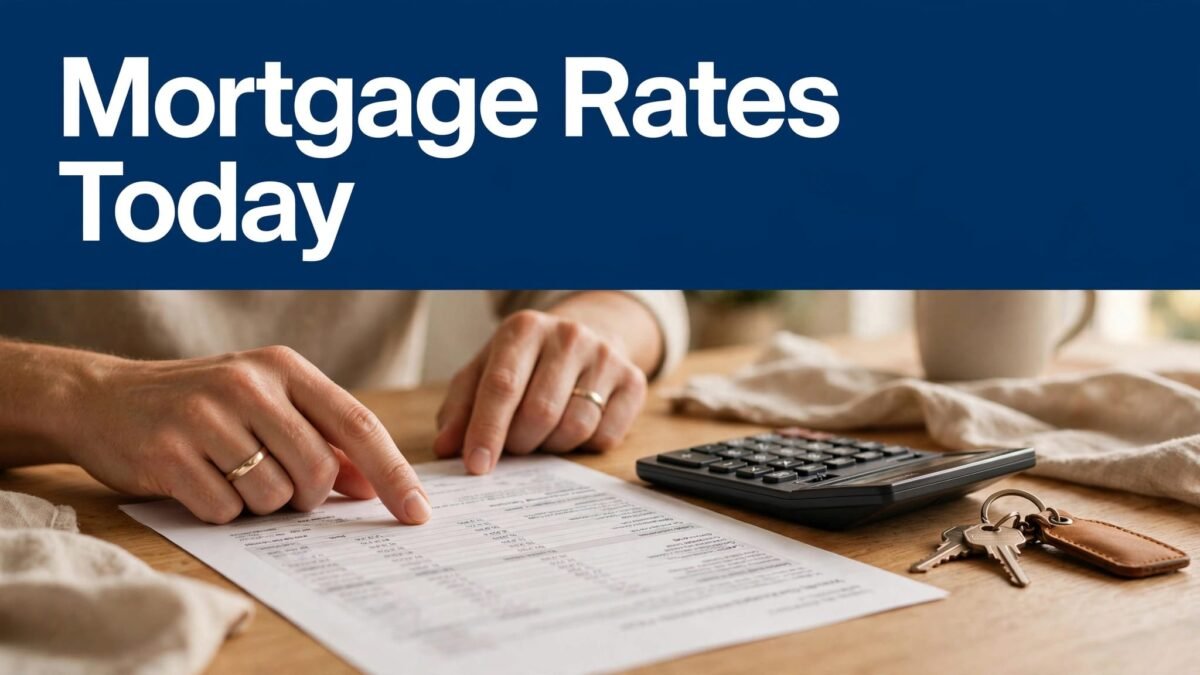
Mortgage rates today can look different on a lender’s website than they do in the offer you receive. An advertised rate may assume a particular credit score, down payment, loan type, and amount paid upfront. Your written quote is what matters for your budget.
The latest national benchmark offers a useful starting point, but rates change, and no survey can price your individual loan. To make sense of an offer, watch the market signals behind rates and compare lenders on the same terms.
Mortgage rates today: the latest benchmark and what it tells buyers
In Freddie Mac’s weekly mortgage-rate survey, the average 30-year fixed mortgage rate was 6.95% as of September 17, 2026. The 15-year fixed average was 6.26%. Both rose from the previous week’s readings.
| Fixed-rate mortgage | September 17, 2026 | September 10, 2026 | Weekly increase |
|---|---|---|---|
| 30-year | 6.95% | 6.76% | 0.19 percentage points |
| 15-year | 6.26% | 6.09% | 0.17 percentage points |
These are dated weekly averages, not live prices or guaranteed offers. A lender may quote a different rate today, and the terms attached to that rate matter as much as the number itself.
Mortgage rates today need a date attached: this benchmark reflects Freddie Mac’s September 17 survey.
Why lender quotes can differ from the weekly average
Your credit score, down payment, loan size, property type, and whether you’ll live in the home can affect pricing. The loan program matters, too. So do lender fees and discount points, which let you pay more upfront for a lower rate.
Use the survey to understand the market’s general direction. For your actual price, request current written quotes based on the same property and borrowing details.

What the weekly rise does and doesn’t mean
The change tells you rates were higher in Freddie Mac’s survey than the week before. It doesn’t tell you whether next week’s average will rise or fall.
If you’re shopping now, check the date beside any rate you see. Then ask whether it includes points, what fees apply, and how long the lender will honor it.
What market signals can push mortgage rates up or down?
Mortgage rates respond to the price investors demand for lending money over long periods. That price can move before a central bank announcement or economic report arrives because markets trade on expectations as well as published figures.
Treasury yields, inflation reports, and jobs data
The 10-year Treasury yield is a useful reference point for fixed mortgage rates. Mortgage pricing often moves in the same broad direction, though the gap between Treasury yields and mortgage rates can change. You can follow the broader trend alongside historical 30-year mortgage averages published by the Federal Reserve Bank of St. Louis.
Inflation readings matter because investors want compensation when they expect money to lose purchasing power faster. Strong jobs or wage data may also lift yields if markets expect inflation to stay elevated. Cooler reports can ease that pressure.
Still, the market reacts to surprises, not just whether a number sounds high or low. A strong jobs report that investors already expected may have less effect than a modest report that surprises them.
How Federal Reserve news affects mortgage pricing
The Federal Reserve sets a short-term policy rate, not a nationwide mortgage rate. A Fed cut therefore doesn’t mean your lender must cut its 30-year fixed rate by the same amount.
Fed decisions and officials’ guidance can change expectations for inflation and future interest rates. Those expectations affect bond yields, which can feed into mortgage pricing. Rates may even move ahead of a widely anticipated decision. For buyers, the useful question is how lenders price loans afterward, rather than whether a headline says the Fed raised or lowered rates.
How to compare mortgage rates, APR, and upfront costs
A low advertised rate can come with a large bill at closing. Ask multiple lenders for loan estimates, then compare offers for the same loan amount, term, rate type, down payment, and property assumptions. Check the date and rate-lock status on each estimate, since an older unlocked offer may no longer be available.
Compare the APR, discount points, and lender fees.
The annual percentage rate (APR) expresses the interest rate plus certain borrowing costs as a yearly rate. It helps expose differences between offers with similar terms, but it doesn’t replace a close look at cash due at closing.
Discount points increase your upfront cost in exchange for a lower interest rate. Lender credits work in the other direction: they reduce certain upfront costs but generally come with a higher rate. Compare origination charges, points or credits, and other lender-controlled costs side by side.
Then consider how long you expect to keep the loan. For example, if paying $2,000 more upfront saves $40 a month, it takes 50 months of savings to recover that extra cost. Selling or refinancing sooner could erase the benefit of buying down the rate.

- Well-spaced keyboard with large, contoured keys for easy operation
- Change sign (+/-) key simplifies entry of negative numbers
- Square root key is useful for schoolwork
Check how the payment fits your budget.
The quoted principal-and-interest payment is only part of homeownership’s monthly cost. Add property taxes, homeowners insurance, mortgage insurance if required, and any homeowners association fees. Also leave room for repairs, which a mortgage quote won’t include.
Lenders calculate eligibility under their own rules, but approval isn’t the same as comfort. If the full payment leaves little room for savings or an unexpected expense, a lower purchase price or larger cash reserve may be more useful than chasing a slightly lower rate.
What a small rate change can do to your payment
The September 17 rise looks small when expressed in percentage points. Over a long repayment period, even a fraction of a point can change the monthly bill.
For illustration, a $300,000 mortgage repaid over 30 years would have a principal-and-interest payment of about $1,948 a month at 6.76%. At 6.95%, it would be about $1,986, roughly $38 more each month. Those figures use the two survey rates as examples, not as offers available to a particular borrower. They exclude taxes, insurance, mortgage insurance, and fees.
The larger lesson isn’t to wait for a particular number. Decide what full monthly housing cost fits your finances, then use that limit when comparing homes and loans. Finance Beacon’s guide to personal finance basics for homebuyers offers a broader way to think about debt, savings, and credit together.
How to get offers that are genuinely comparable
Give each lender the same loan amount, estimated home price, down payment, property use, and requested term. Ask for estimates issued close together, since market pricing can change while you shop. If one lender quotes a 30-year fixed loan and another quotes a 15-year loan, separate them before comparing costs.
Once the estimates arrive, look at the interest rate and APR, then work through points, lender credits, closing costs, estimated cash to close, and the projected payment. Some charges depend on third parties or the property rather than the lender. Ask about any difference you can’t explain instead of assuming every line item is negotiable.
You can also use the Consumer Financial Protection Bureau’s interest-rate comparison tool to see how borrower and loan details can change rate estimates. It provides context for shopping, not a substitute for a lender’s written offer.
Should you lock your rate or wait for a better offer?
A rate lock can protect a buyer under contract from an increase during the agreed lock period, provided the transaction meets the lock’s terms and closes on time. Floating leaves the rate unlocked. It gives you a chance to benefit if pricing improves, but it also exposes you to a higher rate.
Your closing timeline makes the trade-off more concrete. If a higher payment would strain your budget or jeopardize the purchase, the certainty of a suitable lock may matter more than the possibility of a lower quote. If you can absorb a rate increase, floating may be a risk you’re willing to take. Neither choice predicts where rates will go.
Before deciding, ask the lender when the lock expires and whether it costs extra. Find out what happens if closing runs late, what an extension would cost, and whether the lender offers a float-down if rates fall. Get the terms in writing, especially if your contract deadline is close.
Common questions about mortgage rates
Is Freddie Mac’s average the rate I’ll receive?
No. Its survey is a national benchmark for a particular week. Your lender prices a loan using your borrowing details and its own terms. Compare current written offers to find the rate and costs available to you.
Does a lower interest rate always mean a cheaper mortgage?
No. A lower rate may require discount points or higher fees. Compare APR, upfront cash, and the likely time you’ll keep the loan. The cheaper choice over many years may cost more if you sell or refinance early.
Will mortgage rates fall when the Fed cuts rates?
They might, but a cut doesn’t guarantee it. Fixed mortgage rates reflect longer-term bond markets and expectations about inflation and growth. Investors may have priced in a Fed move before it happens.
Can I compare an offer that’s locked with one that isn’t?
You can review their costs, but their rate certainty differs. An unlocked quote may change before you accept it. Ask each lender for the lock status, expiration date, and any associated cost before treating the offers as equivalent.
Do these benchmarks apply outside the United States?
No. Freddie Mac’s survey describes the U.S. mortgage market, and U.S. Loan Estimates follow U.S. rules. Rates, fees, loan structures, and consumer protections differ by country. Buyers elsewhere should use local benchmarks and lender documents.
Choose the full loan, not the headline rate.
The September 17 benchmark gives mortgage rates today a dated reference point, not a personal price. Watch bond yields and economic reports for context, then compare written offers by APR, upfront costs, and the full housing payment.
When it’s time to choose, weigh a rate lock against your closing date and tolerance for a higher payment. The best fit is the loan you can comfortably afford on terms you understand.
Conclusion: Make an Informed Mortgage Decision
Mortgage rates today provide a useful starting point for homebuyers, but the advertised rate tells only part of the story. Understanding market trends, comparing lender offers, and evaluating borrowing costs will help you make a sound financial decision.
Before committing to a mortgage, compare interest rates, APR, discount points, closing costs, and your total monthly housing payment. Consider your credit score, down payment, financial stability, and long-term homeownership plans. If you are approaching your closing date, review your rate-lock options and obtain the terms in writing.
Rather than trying to predict the next rate movement, focus on finding a mortgage within your budget. The right mortgage offers manageable monthly payments, transparent costs, and terms aligned with your financial goals.