In This Article
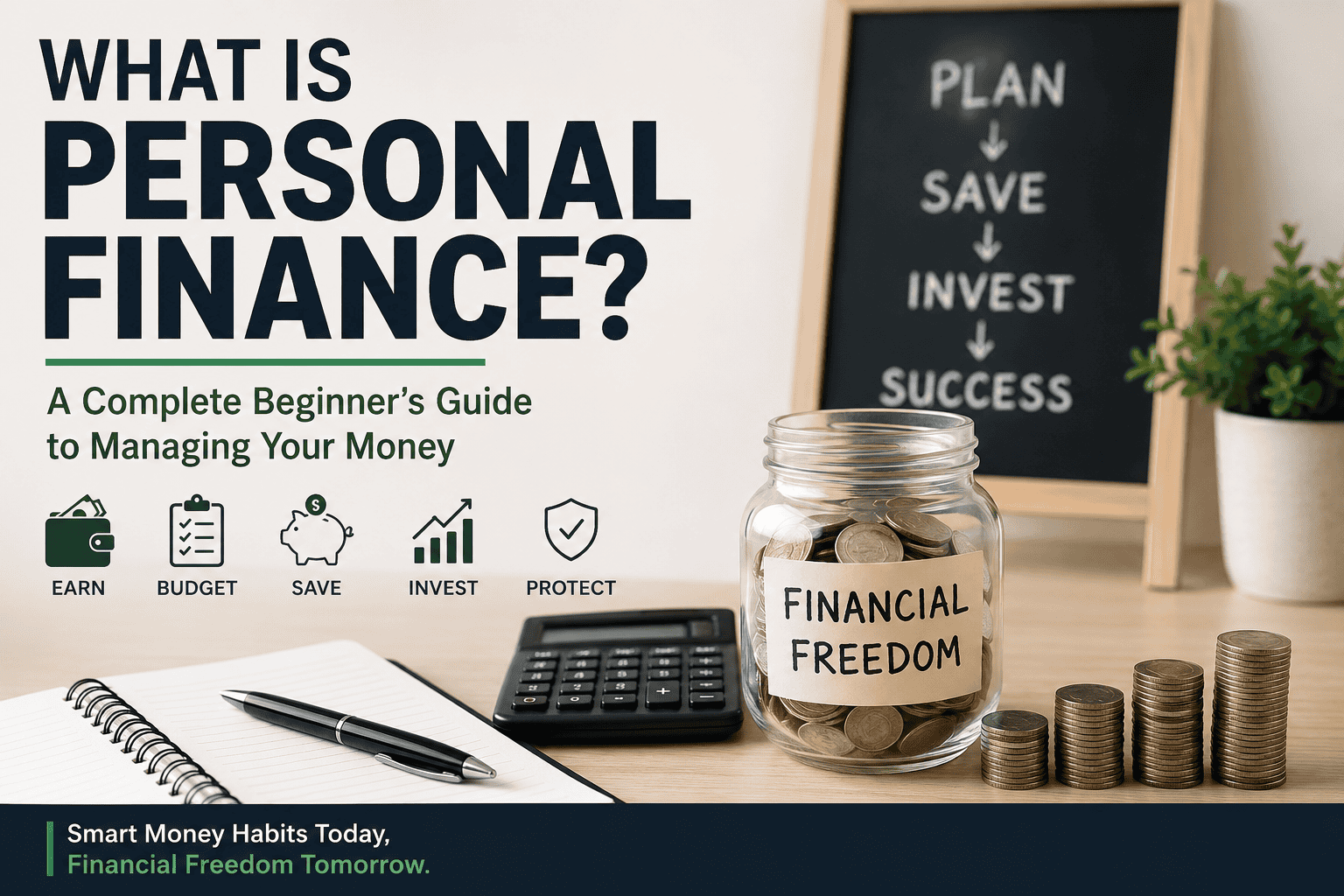
Personal finance is the process of managing your money throughout your life — how you earn it, budget it, save it, invest it, borrow it, protect it, and eventually spend it in retirement. It is not a single skill but a collection of habits and decisions that, together, determine whether your money works for you or against you.
Introduction
Picture two coworkers who start the same job on the same day, earning the exact same salary. The first spends everything each month — new gadgets, frequent takeout, upgrading the car every few years — and by the time a medical bill or a job loss arrives, there is nothing to fall back on. The second earns the same income but follows a simple budget, automatically saves a portion of every paycheck, and invests consistently, even in small amounts. Ten years later, the first coworker is still living paycheck to paycheck, while the second has an emergency fund, a growing investment portfolio, and far less financial stress.
Nothing separates these two people except their relationship with money. Neither is smarter, luckier, or born wealthier. The gap between them is personal finance — the sum of everyday decisions about earning, spending, saving, investing, and protecting money.
“Financial success depends more on consistent habits than on earning a high income.”
Personal finance touches nearly every part of life. It determines how much stress you feel when an unexpected bill arrives, whether you can take time off work without panicking, how comfortably you retire, and how much freedom you have to make choices that align with your values rather than choices forced on you by a shortage of money. The good news is that personal finance is a learnable skill, not an inherited trait. Anyone, regardless of income level, can build the habits that lead to financial stability and long-term wealth.
| Did You Know? The Federal Reserve’s 2024 Survey of Household Economics and Decisionmaking found that only 63% of U.S. adults could cover a hypothetical $400 emergency expense with cash or its equivalent — meaning more than a third could not. (Federal Reserve, 2025) |
This guide walks through everything a beginner needs to understand: what personal finance actually means, why it matters, the five foundational pillars that support it, and practical, actionable steps for budgeting, saving, managing debt, building credit, investing, planning for retirement, and protecting what you build along the way.
What Is Personal Finance?
Personal finance is the practice of managing your individual or household financial activities — earning, spending, saving, investing, borrowing, and protecting money — in a way that supports both your immediate needs and your long-term goals.
It covers a wide range of activities:
- Income management — how you earn money and how efficiently you use it
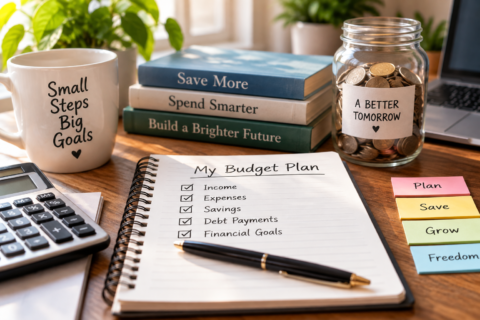
- Budgeting — deciding in advance where your money will go
- Saving — setting money aside for future needs, both planned and unexpected
- Investing — putting money to work so it grows over time
- Debt and credit management — borrowing responsibly and maintaining a healthy credit profile
- Tax planning — understanding and minimizing your tax burden legally
- Retirement planning — preparing financially for the years when you no longer work
- Insurance and protection — safeguarding your income, assets, and family against unexpected events
Personal finance is “personal” because there is no single formula that works for everyone. A 25-year-old just starting a career, a 40-year-old supporting a family, and a 65-year-old approaching retirement all have different priorities, risk tolerances, and time horizons. What stays constant is the underlying framework: understand what you have, decide where it should go, and make consistent decisions that move you toward your goals. A good place to put that framework into practice is How to Create a Budget That Actually Works, which walks through building a budget step by step.
Why Personal Finance Matters
Understanding personal finance is not about becoming obsessed with money — it is about giving yourself options and reducing unnecessary stress. Here is why it matters:
- Control your money instead of it controlling you. When you know exactly where your money goes, you stop wondering where your paycheck disappeared to by the middle of the month.
- Reduce financial stress. Money problems are consistently ranked among the top sources of stress and relationship strain. A clear financial plan removes much of that anxiety.
- Achieve financial goals. Whether the goal is buying a home, starting a business, traveling, or retiring comfortably, none of it happens by accident — it happens through planning.
- Avoid costly mistakes. Missed payments, high-interest debt, and poor investment decisions can set you back years. Financial literacy helps you avoid these traps.
- Build long-term wealth. Small, consistent financial habits compound over decades into meaningful wealth, even for people who never earn a high salary.
| FinanceBeacon Tip Financial stress rarely comes from how much you earn — it comes from not knowing where your money goes. A five-minute weekly check-in on your spending can head off most of it. |
The Five Pillars of Personal Finance
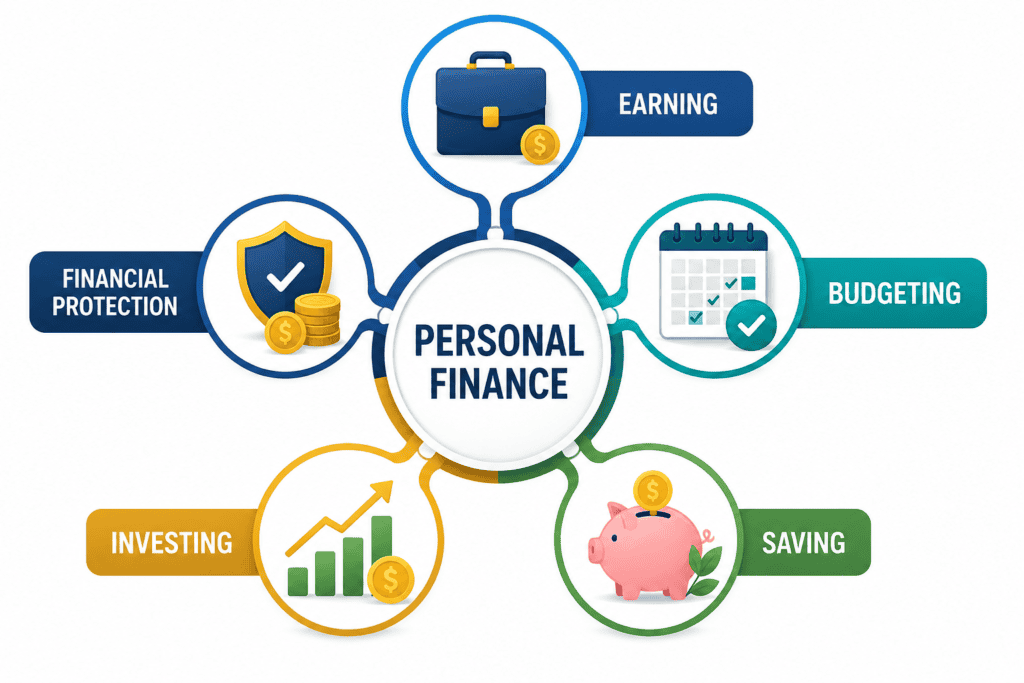
Nearly every financial decision falls under one of five pillars. Mastering these five areas gives you a complete financial foundation.
- Earning — the income you generate through work, business, or other sources, and how you can grow it over time.
- Budgeting — the process of planning how your income will be spent, saved, and invested before the month begins.
- Saving — setting aside money for short-term needs, emergencies, and future goals.
- Investing — putting money into assets that grow over time, allowing your wealth to outpace inflation.
- Protection — using insurance, emergency funds, and estate planning to guard against events that could undo your financial progress.
Each pillar depends on the others. A high income without budgeting evaporates quickly. Aggressive investing without an emergency fund can force you to sell assets at the worst possible time. Understanding how these pillars work together is the foundation of sound personal finance.
How to Create a Budget That Actually Works
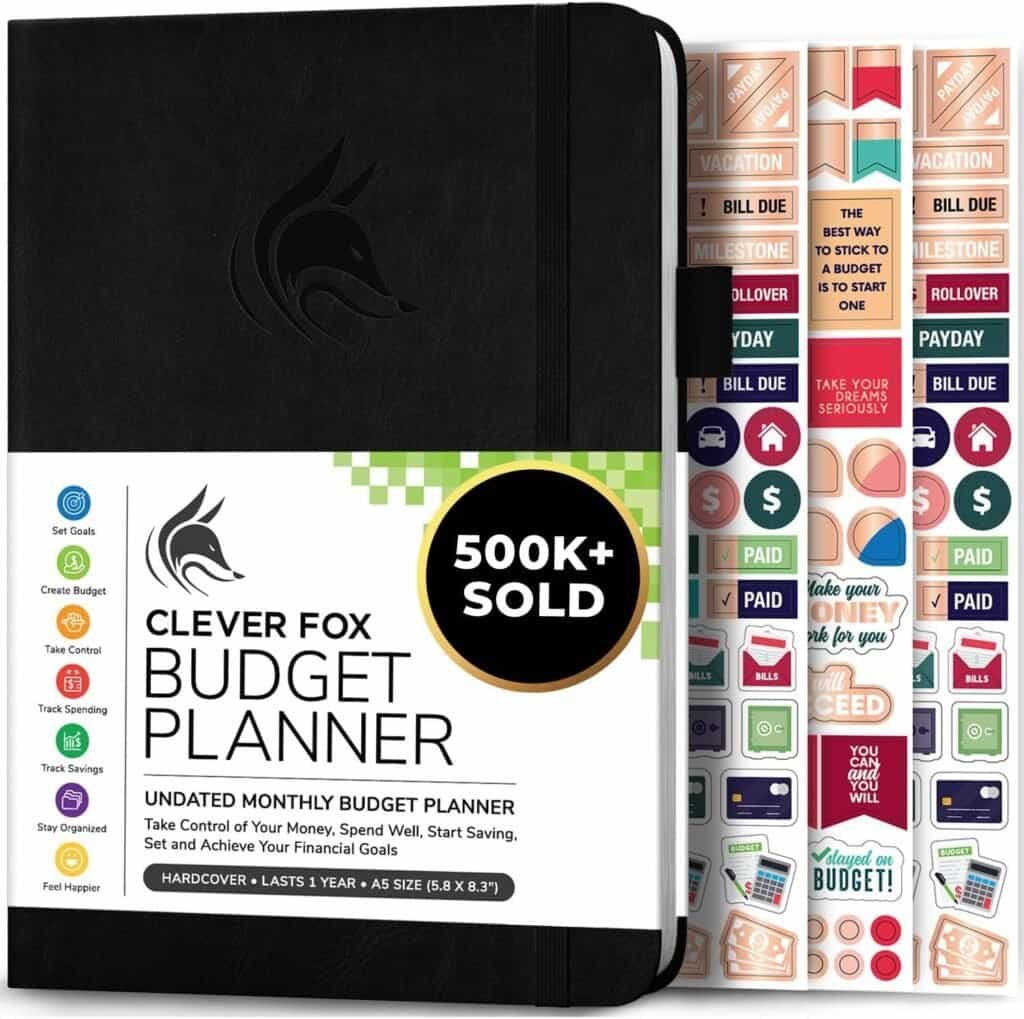
Recommended Budget Planner: If you prefer writing your budget instead of using an app, the Clever Fox Budget Planner helps you track income, expenses, savings goals, and debt repayment in one place. It is an excellent tool for building consistent money management habits.
A budget is simply a plan for your money — it tells every dollar where to go before you spend it, rather than wondering afterward where it went.
“Budgeting gives every dollar a purpose.”
Step 1: Calculate your total income. Add up all sources of take-home income: salary, freelance work, side hustles, and any other regular earnings.
Step 2: Track your expenses. For at least one month, record everything you spend. Many people are surprised by how much goes to small, recurring purchases like subscriptions or daily coffee.
Step 3: Separate needs from wants. Needs are essentials — rent, groceries, utilities, transportation, minimum debt payments. Wants are everything else — dining out, entertainment, upgrades, and non-essential shopping.
Step 4: Choose a budgeting method. Two popular approaches:
- The 50/30/20 rule — 50% of income to needs, 30% to wants, and 20% to savings and debt repayment.
- Zero-based budgeting — every dollar of income is assigned a specific job (spending, saving, or investing) until the balance reaches zero.
Step 5: Pay yourself first. Before spending on anything discretionary, set aside your planned savings and investment contributions. Treating savings like a non-negotiable bill is one of the most effective habits in personal finance.
Step 6: Review and adjust monthly. A budget is not a static document. Review it every month, compare it against what actually happened, and adjust categories as your income or priorities change.
Recommended Budgeting Tools
A physical planner works well for people who find a dedicated notebook easier to stick with than an app. The Clever Fox Budget Planner is a structured, undated planner built around monthly and weekly budgeting spreads, useful for beginners who want guided prompts rather than a blank page. The Legend Budget Planner offers a similar undated, guided layout with expense trackers and savings goal pages, and suits people who like checking boxes and writing numbers by hand rather than typing them into an app.
Building an Emergency Fund
An emergency fund is money set aside specifically for unexpected expenses — a job loss, medical emergency, car repair, or urgent home repair. Without one, an unexpected expense often gets paid for with high-interest debt, which can take months or years to pay off.
| Common Beginner Mistake Waiting until you have “extra” money to start an emergency fund. Most successful savers start with automatic transfers of $10-$25 per paycheck rather than waiting for a windfall. |
Where to start: If you are just beginning, aim for a starter emergency fund of $500 to $1,000. This covers most small emergencies and prevents you from reaching for a credit card at the first sign of trouble.
The next milestone: Once your starter fund is in place and any high-interest debt is under control, build toward three to six months of essential living expenses — rent or mortgage, utilities, groceries, insurance, and minimum debt payments. Self-employed individuals or those with unpredictable income should lean toward the higher end of that range.
Only about 48% of U.S. adults said they could cover a $2,000 expense using savings alone, according to the Federal Reserve’s 2024 household survey — a reminder of how thin many families’ financial buffers really are. (Federal Reserve, 2025)
Where to keep it: An emergency fund should be liquid and safe — not invested in the stock market. A high-yield savings account is typically the best home for it, since it stays accessible while still earning some interest.
How to build it: Automate a fixed transfer to your emergency savings account every payday, even if the amount is small at first. Consistency matters more than speed. For a closer look at sizing your cushion to your own situation, see Emergency Funds Explained: How Much Should You Save?
Recommended Savings Tools
A high-yield savings account, where available, is generally the most effective home for an emergency fund since it keeps the money liquid while still earning interest. For people who prefer a hands-on, cash-based approach, a cash envelope wallet can help enforce spending limits by category, and a lockable savings box adds a small psychological barrier that discourages dipping into savings on impulse.
Understanding Debt
Not all debt is harmful. Understanding the difference between productive and destructive debt is essential to using credit wisely.
Good debt is generally debt used to acquire an asset or capability that increases in value or earning potential over time — a mortgage on a home, a reasonably priced student loan, or a business loan that generates income.
Bad debt is typically high-interest debt used to fund depreciating assets or lifestyle spending — credit card balances carried month to month, high-interest personal loans for non-essential purchases, or “buy now, pay later” plans stacked on top of an already tight budget.
Common types of debt beginners encounter:
- Credit card debt — usually the highest-interest and most dangerous type of debt if carried month to month, since interest compounds quickly on unpaid balances.
- Student loans — can be a reasonable investment in future earning potential, but the terms and total amount borrowed matter enormously.
- Auto loans — financing for a depreciating asset; keeping loan terms short and the loan amount reasonable relative to income helps limit risk.
- Mortgages — typically the largest debt most people take on, generally considered good debt because it finances an appreciating asset and often comes with comparatively low interest rates.
- Personal loans — can be useful for consolidating higher-interest debt, but risky when used to fund ongoing lifestyle spending.
| Good Debt | Bad Debt |
| Mortgage | Credit card debt |
| Student loan | Payday loan |
| Business loan | Luxury purchases |
| Investment loan | Holiday financing |
U.S. credit card balances reached $1.25 trillion in the first quarter of 2026, up 5.9% from a year earlier, according to the Federal Reserve Bank of New York’s Household Debt and Credit Report — a reminder of how quickly high-interest balances can build. (Federal Reserve Bank of New York, 2026)
Repayment strategies:
- The debt snowball method — pay off the smallest balance first while making minimum payments on the rest, then roll that payment into the next-smallest balance. This method builds motivation through quick wins.
- The debt avalanche method — pay off the debt with the highest interest rate first while making minimum payments on the rest. This method saves the most money in interest over time.
Whichever method you choose, the key principle is the same: avoid taking on new high-interest debt while paying down existing balances, and always pay at least the minimum on every debt to protect your credit history. For a deeper breakdown of which debts help you and which hurt you, see Good Debt vs Bad Debt Explained.
Recommended Debt Reduction Resources
A dedicated debt payoff planner can help by laying out every balance, interest rate, and minimum payment in one place, making it easier to choose and stick with either the snowball or avalanche method. A broader financial workbook that covers budgeting alongside debt payoff can also help connect debt reduction to your overall spending plan, rather than treating it as an isolated goal.
Understanding Credit Scores
Your credit score is a numerical reflection of how reliably you have borrowed and repaid money in the past. Lenders, landlords, insurers, and sometimes even employers use it to judge financial reliability.
What affects your score:
- Payment history — paying bills on time is typically the single largest factor.
- Credit utilization — how much of your available credit you are using; keeping balances well below your limits helps your score.
- Length of credit history — older accounts in good standing generally help.
- Credit mix — a healthy combination of credit types (credit cards, loans) can help.
- New credit inquiries — applying for many new accounts in a short period can temporarily lower your score.
| Quick Win Set up autopay for at least the minimum payment on every account. Missing a due date, even by a few days, can affect your score far more than carrying a small balance. |
How to build and protect your score:
- Pay every bill by its due date, without exception.
- Keep credit card balances low relative to your limit.
- Avoid opening several new credit accounts at once.
- Check your credit report regularly for errors or signs of fraud.
A strong credit score can save you significant money over a lifetime through lower interest rates on mortgages, auto loans, and credit cards.
Recommended Credit Monitoring Services
A credit monitoring service can alert you to new accounts, hard inquiries, or sudden score changes that may signal fraud. Pairing this with identity theft protection adds a layer of monitoring for your personal information beyond just your credit file, while a credit report monitoring tool makes it easy to check your full report periodically for errors without having to request it manually each time. Choose a reputable, well-reviewed provider rather than the cheapest option available.
Investing for Beginners
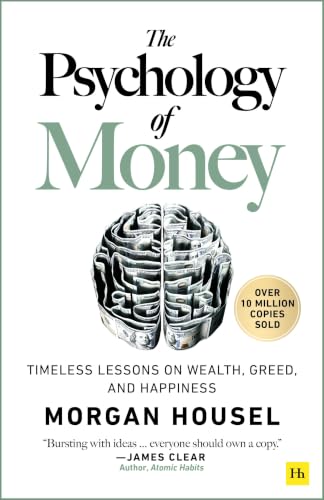
The Psychology of Money explains why financial success depends more on behavior than intelligence. It is one of the best beginner-friendly books on saving, investing, and building long-term wealth.
Saving alone is not enough to build long-term wealth, because inflation gradually erodes the purchasing power of cash sitting idle. Investing puts your money to work so it can grow faster than inflation over time.
Core principles for beginners:
- Start as early as possible. Because of compound growth, money invested in your 20s has decades longer to grow than money invested in your 40s, even if the total amount contributed is smaller.
- Diversify. Spreading investments across different assets — stocks, bonds, and funds that track broad markets — reduces the risk of any single investment derailing your plan.
- Invest consistently. Contributing a fixed amount on a regular schedule, regardless of market conditions, removes the temptation to try to “time the market” and smooths out the effect of short-term volatility.
- Understand your risk tolerance and time horizon. Money you will need in the next few years should generally be kept more conservative, while money you will not touch for decades can typically afford to take on more risk in pursuit of higher long-term returns.
- Let compound growth work for you. Investment returns generate their own returns over time, which is why consistent, long-term investing tends to outperform sporadic, short-term attempts to beat the market.
“Small financial decisions repeated consistently create extraordinary results.”
Beginners often start with employer-sponsored retirement accounts, low-cost index funds, or other diversified funds before moving into more specific investment strategies as their knowledge and confidence grow.
Common account types beginners encounter:
- Employer-sponsored retirement accounts — often come with tax advantages and, in many cases, employer matching contributions.
- Individual retirement accounts — personal accounts opened outside of an employer, offering additional tax-advantaged ways to invest for retirement.
- Standard brokerage accounts — flexible, taxable investment accounts with no restrictions on when funds can be withdrawn, useful for goals outside of retirement.
A note on risk: All investing carries risk, and account values can fall as well as rise. The goal is not to avoid risk entirely but to manage it — taking on a level of risk appropriate to your timeline and goals, and staying invested through short-term market swings rather than reacting emotionally to every dip. New investors who want a fuller walkthrough of account types and strategy can start with the Beginner’s Guide to Investing.
Consistent investing and compound growth help transform small contributions into significant long-term wealth.
Recommended Beginner Investing Books
The Psychology of Money is best suited for readers who want to understand the emotional and behavioral side of money before diving into strategy. The Simple Path to Wealth works well for beginners who want a straightforward, no-jargon explanation of long-term index investing. The Little Book of Common Sense Investing is a good fit for readers who want the case for low-cost, diversified investing explained clearly and concisely. The Richest Man in Babylon suits readers who prefer timeless, story-based lessons on saving and building wealth over technical detail.
Retirement Planning
Retirement planning is the process of ensuring you will have enough income to cover your living expenses once you are no longer working.
Start early. Time is the most powerful factor in retirement planning. Contributions made early in your career benefit from decades of compound growth, meaning even modest amounts invested in your 20s can outgrow larger amounts invested later.
Contribute consistently. Where available, take full advantage of employer-sponsored retirement plans, especially if your employer matches contributions — that match is effectively free money.
Only 35% of non-retired adults said they felt their retirement savings plan was on track, according to the Federal Reserve’s 2024 Survey of Household Economics and Decisionmaking — down from 40% in 2021. (Federal Reserve, 2025)
| Expert Insight Retirement confidence has hovered between roughly 31% and 40% for several years running, according to Federal Reserve survey data — a sign that starting early and contributing consistently matters more than trying to make up for lost time later. |
Estimate your retirement needs. A common guideline is that you will need a significant percentage of your pre-retirement income to maintain your lifestyle in retirement, though the exact figure depends on your expected expenses, healthcare needs, and desired retirement lifestyle.
Review your plan regularly. Life circumstances change — income grows, family needs shift, and retirement timelines move. Revisit your retirement plan at least once a year to make sure your contributions and investment choices still align with your goals. Those just getting started should check out Retirement Planning for Beginners for a step-by-step walkthrough.
Recommended Retirement Planning Resources
A retirement planner, whether a physical workbook or a digital tool, can help you map out contribution targets against your expected retirement age. Financial planning software can go a step further by modeling different savings and withdrawal scenarios, while a simple retirement calculator is often enough for a beginner who just wants a rough estimate of whether current contributions are on pace to meet future needs.
Insurance and Financial Protection
Insurance exists to protect the financial progress you have already made from being wiped out by an unexpected event. It is one of the most overlooked pillars of personal finance, yet one of the most important.
- Health insurance protects against the potentially devastating cost of medical care.
- Life insurance provides financial support for dependents if the policyholder passes away, particularly important for anyone with a spouse, children, or other dependents relying on their income.
- Auto insurance covers damage and liability related to vehicle accidents.
- Disability insurance replaces a portion of income if illness or injury prevents you from working — a risk that is often underestimated but statistically significant over a career.
- Property insurance (renters or homeowners) protects your home and belongings against damage, theft, or loss.
The right amount and type of coverage depends on your age, dependents, assets, and income, but skipping insurance entirely to save money is one of the riskiest financial decisions a person can make, since a single uninsured event can undo years of careful saving and investing.
Personal Finance Life Cycle
Financial priorities are not static — they shift as you move through different stages of life.
- Early career: Focus on building financial habits, starting an emergency fund, paying down any high-interest debt, and beginning retirement contributions, even small ones.
- Mid-career: Priorities often expand to include homeownership, family expenses, increasing retirement contributions, and possibly funding children’s education.
- Pre-retirement: Focus shifts toward maximizing retirement savings, paying off remaining debt, and gradually adjusting investment risk as retirement approaches.
- Retirement: The focus moves from accumulating wealth to managing and withdrawing it sustainably, while maintaining adequate insurance and protecting savings from being depleted too quickly.
Recognizing which stage you are in helps you prioritize the right financial actions rather than applying a one-size-fits-all approach.
Setting Financial Goals That Actually Stick
Vague goals like “save more money” rarely lead to action because there is no clear finish line and no way to measure progress. Effective financial goals tend to share a few characteristics:
- Specific — “Save $3,000 for a car down payment” rather than “save more.”
- Measurable — a defined dollar amount or percentage makes progress easy to track.
- Time-bound — a target date creates urgency and helps determine how much needs to be saved each month.
- Realistic — ambitious enough to matter, but achievable given your actual income and expenses.
It also helps to separate goals by time horizon. Short-term goals (within a year) might include building a starter emergency fund or paying off a small debt. Medium-term goals (one to five years) might include a larger emergency fund, a car purchase, or a wedding. Long-term goals (five-plus years) typically include retirement, buying a home, or funding a child’s education. Assigning each goal its own savings or investment plan — rather than lumping everything into one account — makes it much easier to track progress and stay motivated.
Ten Habits of Financially Successful People
- Spend less than you earn, consistently.
- Maintain and follow a budget.
- Automate savings so it happens without relying on willpower.
- Invest consistently, regardless of market conditions.
- Avoid unnecessary or high-interest debt.
- Keep learning about personal finance and investing.
- Plan ahead for major expenses instead of reacting to them.
- Maintain a fully funded emergency fund.
- Review finances regularly — monthly or quarterly.
- Set clear, specific financial goals with timelines.
Common Money Mistakes
- Living without a budget — spending reactively instead of intentionally.
- Ignoring savings — treating saving as an afterthought rather than a priority.
- Delaying investing — waiting for the “right time” and losing years of potential compound growth.
- Carrying high-interest debt — letting credit card balances grow instead of paying them down aggressively.
- Emotional spending — using purchases to cope with stress, boredom, or social pressure.
- Failing to review progress — never checking whether your financial plan is actually working.
Avoiding these mistakes is often more impactful than finding a clever financial “hack,” since consistency and discipline outperform short-term tricks over the long run. In fact, 73% of U.S. adults described themselves as “doing okay” or “living comfortably” financially in the Federal Reserve’s 2024 survey — a figure driven far more by financial habits than by income level alone. (Federal Reserve, 2025)
Tools That Make Personal Finance Easier
You do not need expensive software to manage your money well, but the right tools can remove friction and make good habits easier to maintain.
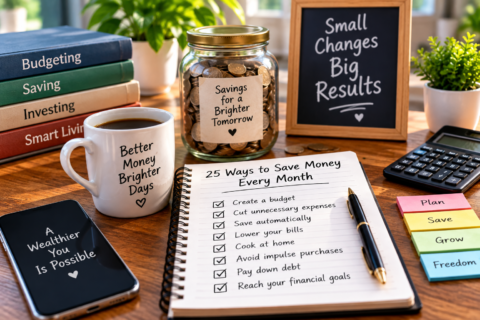
- Budgeting apps or spreadsheets — whether a dedicated app or a simple spreadsheet, having one place to see income and expenses side by side makes budgeting far easier to stick with.
- Automatic transfers — setting up automatic transfers to savings and investment accounts on payday removes the temptation to skip a month.
- Bill payment reminders — calendar alerts or autopay for recurring bills help protect your payment history and credit score.
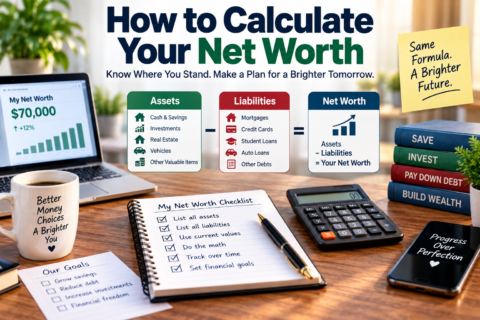
- Net worth tracking — periodically calculating total assets minus total debts gives a simple, powerful snapshot of overall financial progress that a monthly budget alone doesn’t capture.
The specific tool matters far less than using it consistently. A simple spreadsheet updated every week will outperform a sophisticated app that gets abandoned after a month.
30-Day Action Plan
Helpful Financial Tool: A financial calculator makes it easier to calculate loan repayments, investment growth, savings goals, and retirement plans. The Casio FC-200V is widely used by students, finance professionals, and anyone serious about managing money.

- 4-line display
- Impact protection cover
- Statistical functions: regressions, sums, standard deviation
Week 1: Track every dollar of income and every expense to get a clear, honest picture of your current financial situation.
Week 2: Open a dedicated savings account and start building your emergency fund, even with a small automatic transfer.
Week 3: List out all existing debts with their balances and interest rates, choose a repayment strategy, and research the basics of investing.
Week 4: Review your progress from the first three weeks, adjust your budget based on what you learned, and set clear financial goals for the next 90 days.
Frequently Asked Questions
What is the easiest way to start budgeting?
Start by tracking your actual spending for one month before creating any budget categories. Seeing where your money currently goes makes it much easier to build a realistic plan.
How much should I save each month?
A common target is at least 20% of your income toward savings and debt repayment, but even a smaller percentage is a strong start if it is consistent and grows over time.
How big should my emergency fund be?
Begin with $500 to $1,000, then work toward three to six months of essential living expenses.
How do I start investing with a small amount of money?
Many beginners start with employer-sponsored retirement plans or low-cost diversified funds, contributing consistently even in small amounts rather than waiting until they have a large sum to invest.
What is the fastest way to pay off debt?
The debt avalanche method (highest interest rate first) typically saves the most money, while the debt snowball method (smallest balance first) can be more motivating for people who benefit from quick wins.
Do I really need insurance if I’m young and healthy?
Yes. Insurance protects against low-probability, high-impact events. Being young and healthy reduces some risks but does not eliminate the financial danger of an accident, illness, or unexpected liability.
Should I pay off debt or save first?
Most experts recommend building a small starter emergency fund first, then aggressively paying down high-interest debt, then building your full emergency fund and increasing investments. This order prevents new debt from being created by future emergencies while still limiting the damage of high-interest balances.
Is it too late to start if I’m already in my 30s, 40s, or older?
No. While starting earlier gives compound growth more time to work, meaningful progress is possible at any age. The most important factor is starting consistent habits today rather than waiting for a “perfect” starting point.
What’s the difference between a want and a need?
A need is essential for basic living and functioning — housing, food, utilities, transportation to work, and minimum debt payments. A want improves comfort or enjoyment but is not essential — dining out, entertainment subscriptions, and non-essential upgrades. The line can be blurry, so it helps to ask whether a lower-cost alternative could meet the same underlying need.
How often should I review my finances?
A brief check-in weekly or biweekly helps you stay aware of spending, while a deeper review monthly is useful for adjusting your budget. A full review of goals, investments, and insurance once or twice a year is generally sufficient.
Key Takeaways
Personal finance is a lifelong process, not a one-time project. It is built on five interconnected pillars — earning, budgeting, saving, investing, and protection — and it evolves as your life circumstances change. The specific numbers and strategies will differ from person to person, but the underlying principles remain the same: spend intentionally, save consistently, invest early, borrow responsibly, and protect what you build.
Personal Finance Checklist
☐ Create a budget
☐ Track expenses
☐ Build an emergency fund
☐ Pay off high-interest debt
☐ Begin investing
☐ Review finances monthly
Recommended Personal Finance Resources
A Budget Planner gives beginners a guided, structured place to build their first monthly budget without starting from a blank page. An Expense Tracker makes it easier to log day-to-day spending as it happens rather than trying to reconstruct it at the end of the month. A Financial Calculator helps with quick math on savings goals, loan payoff timelines, or investment growth. Investing Books are useful for building a foundation of knowledge before committing real money to the markets. A Money Management Spreadsheet suits people who prefer full control over their own categories and formulas. A Financial Literacy Course can help tie all of these pieces together into a structured learning path for readers who want more than a single guide can offer.
Conclusion
Financial success is rarely the result of a high income or a lucky break — it is the result of consistent, informed habits practiced over years and decades. You do not need to master every concept in this guide today. Start with one positive financial decision — tracking your spending for a month, opening a savings account, or setting up your first automatic transfer — and let that single step build momentum toward the next. Over time, those small, consistent decisions compound into real financial freedom.