
In This Article
A car repair bill lands in your inbox. A pipe bursts under the kitchen sink. A round of layoffs reaches your department. None of these events is rare, and none waits for a convenient month. Whether they become stressful depends on one thing. Do you have an emergency fund to absorb the hit?”
An emergency fund is a stash of cash set aside for unexpected, essential expenses—money that is not earmarked for rent, groceries, or your next vacation. It exists purely to be there when something goes wrong. In this guide, you will learn what counts as a true emergency, how much you should realistically aim to save, where to keep that money so it stays safe and accessible, and a practical, step-by-step plan for building your fund from wherever you are starting today.
What Counts as a Financial Emergency
Not every unplanned expense is an emergency. Concert tickets, a holiday sale, or a spontaneous weekend trip are wants, not emergencies, even when they feel urgent. A true emergency is usually unexpected, necessary, and urgent—all three at once.
Common examples include:
- Job loss or a sudden drop in income
- Urgent medical or dental care
- Essential car repairs needed to get to work
- Home repairs that affect safety, such as a broken furnace or a leaking roof
- Unavoidable travel for a family emergency
Even a routine vehicle breakdown can create a large unexpected expense, especially for households without dedicated emergency savings. Expenses like these are precisely why a dedicated fund matters.
Why an Emergency Fund Matters More Than It Seems
It is easy to assume you will handle an emergency “when it happens.” The data suggests otherwise for a large share of Americans. The Federal Reserve’s 2025 Survey of Household Economics and Decisionmaking (SHED), fielded in October 2025, found that only 63 percent of adults could cover a hypothetical $400 expense using cash or its equivalent—a figure that has been flat since 2022 after peaking at 68 percent in 2021. That means more than a third of adults would need to borrow, sell something, or skip the expense entirely to handle a $400 surprise.
Overall financial well-being shows a similar trend. Some 73 percent of adults said they were “doing okay” or “living comfortably” in 2025, unchanged from 2024 but below the 78 percent high recorded in 2021.
What Larger Emergencies Reveal
Larger expenses reveal an even bigger gap. Bankrate’s 2026 Annual Emergency Savings Report found that only 47 percent of Americans had enough liquidity to cover a $1,000 emergency expense, and nearly one in four adults reported having no emergency savings at all.
Finance Beacon Tip: An emergency fund is not about predicting exactly what will go wrong. It is about making sure that whatever does go wrong does not force you into high-interest debt.
Without savings set aside, an emergency expense often gets paid for with a credit card, a payday loan, or a withdrawal from a retirement account—all of which can turn a one-time problem into a long-term financial setback through interest charges, early withdrawal penalties, or lost investment growth.
None of these factors means you can’t be prepared. Instead, it means the “right” emergency fund target genuinely depends on where you live, how stable your income is, and what safety nets already exist around you—which is exactly why the next section walks through how to calculate a personal number instead of borrowing someone else’s.
How Much Should You Save in an Emergency Fund?
A common long-term target is three to six months of essential expenses, adjusted for your income stability and household obligations. That range exists for a reason: it accounts for the fact that different households face different levels of financial risk, so no single number works for everyone.
The Standard Rule and Why It’s a Range, Not a Number
Three months tends to suit people with stable, predictable income and a second earner in the household. Six months—or more—tends to suit people with less predictable income, a single-income household, or a physically demanding job that is harder to replace quickly. There is no universal “correct” number. Instead, your target should reflect your income stability, obligations, and risk tolerance.
Factors That Push Your Target Higher
Several situations justify saving toward the higher end of the range, or even beyond six months:
- Self-employment, freelance work, or commission-based income makes earnings less predictable.
- Your household relies on a single income
- You work in a cyclical or seasonal industry
- Dependents, including children or aging parents, increase your financial responsibilities.
- Unpredictable essential expenses also support keeping a larger emergency fund.
- Limited insurance coverage, such as a lack of short-term disability protection, increases your financial exposure.
Factors That May Allow a Smaller Target
On the other hand, a smaller fund may be reasonable if you have strong safety nets elsewhere:
- A stable government or tenured position provides greater income security.
- A working spouse or partner with separate income provides another household income source.
- Access to a strong severance policy provides an additional financial cushion.
- Minimal fixed monthly obligations reduce the amount of emergency savings you need each month.
- Other liquid assets provide another source of funds during an emergency.
How to Calculate Your Own Emergency Fund Number
Rather than guessing, calculate your target using your actual essential monthly costs. Essentials typically include:
- Housing (rent or mortgage payment)
- Utilities
- Groceries
- Minimum debt payments
- Insurance premiums
- Transportation costs
- Any required childcare or medical costs
Add these together to find your “bare minimum” monthly spending, then multiply by your chosen number of months. For example, if your essential monthly spending is $2,800, a three-month fund would be $8,400, and a six-month fund would be $16,800.
If you have not created a spending plan yet, our Budgeting for Beginners guide walks you through tracking income, expenses, needs, wants, and savings goals.
Finance Beacon Tip: Calculate your number using essential spending only—not your full current budget. The goal during an emergency is to cover survival costs, not maintain your normal lifestyle.

- TAKE CONTROL OF YOUR MONEY & ACHIEVE YOUR FINANCIAL GOALS – Are you looking for the best monthly budget planner to keep …
- FIND THE BEST WAY TO ACHIEVE YOUR FINANCIAL GOALS – This budget organizer is not just a tool; it’s a framework for achie…
- EASILY CONTROL YOUR SPENDING, DEBTS & SAVINGS – This money planner is undated and covers 12 months. Every month features…
BUDGET PLANNER AND EXPENSE TRACKER
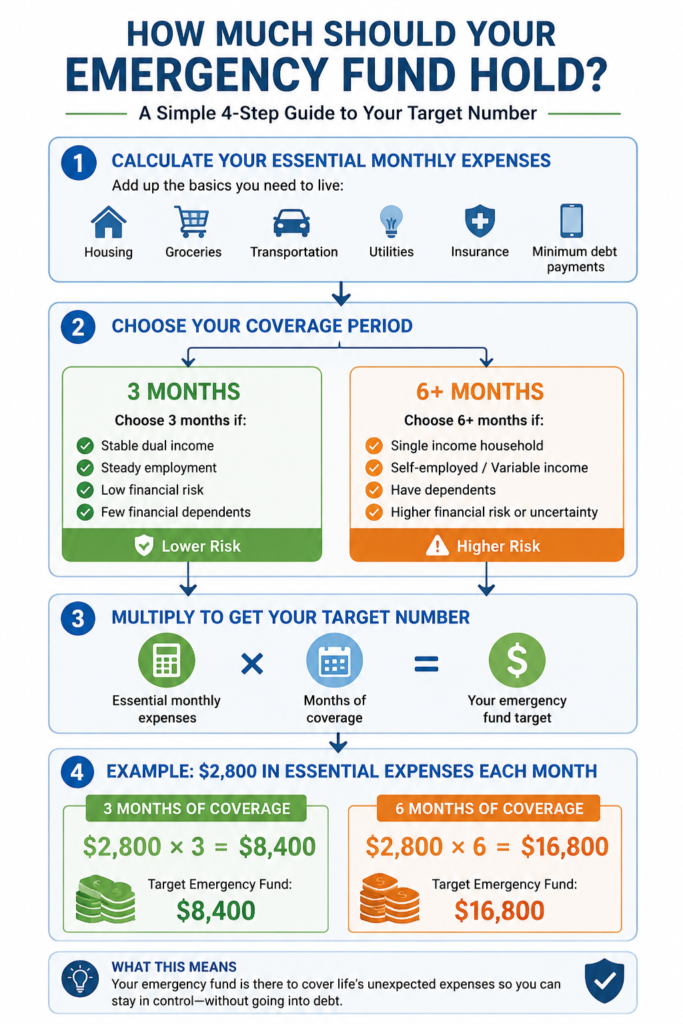
HOW MUCH SHOULD YOUR EMERGENCY FUND HOLD?
Where Should You Keep Your Emergency Fund?
Where you keep this money matters almost as much as how much you save. The right account balances three priorities: safety, accessibility, and a reasonable return. You should never invest a good emergency fund in anything that can lose value right when you need it.
High-Yield Savings Accounts
For most people, a high-yield savings account (HYSA) at an FDIC-insured online bank is the best home for an emergency fund. These accounts combine same-day or next-day access to your money with meaningfully better interest rates than a typical brick-and-mortar bank.
High-yield savings accounts often pay substantially more than traditional savings accounts. Because rates change frequently, compare current APYs before opening an account. As a rough illustration, a several-percentage-point difference in APY can add up to hundreds of dollars a year in extra interest on a balance of several thousand dollars, so it is worth checking a handful of current offers before you decide where to open your account.
Money Market Accounts
A money market account operates like a savings account but sometimes includes check-writing privileges or a debit card, which can make it easier to access funds directly in an emergency. Money market deposit accounts at FDIC-insured banks receive FDIC protection up to applicable limits. Similar accounts at federally insured credit unions receive NCUA coverage instead. This account is different from a money market mutual fund, an investment product that does not carry FDIC or NCUA deposit insurance, so it is worth confirming which type of “money market” product you are opening before you rely on it for emergency savings.
Certificates of Deposit and CD Ladders
Certificates of deposit generally are not a good place for your entire emergency fund, since withdrawing money before the term ends usually triggers a penalty. However, some savers use a CD ladder—splitting savings across CDs with staggered maturity dates—to hold a portion of a larger fund once their core three-month cushion is already sitting in a fully liquid account. This approach only makes sense for the excess above your minimum liquid target.
Why a Regular Checking Account Usually Falls Short
Keeping emergency savings in your everyday checking account is convenient, but it comes with two downsides. First, checking accounts typically pay little to no interest. Second, money that is easy to see and easy to spend is more likely to be used for non-emergency expenses. Separating your emergency fund into its own account, at a different institution if possible, creates a helpful mental and practical barrier.
What About Cash at Home?
A small amount of physical cash—enough to cover a day or two of essentials—can be useful during a power outage, natural disaster, or system outage that temporarily blocks electronic access to your accounts. However, cash at home earns no interest, offers no protection against theft or fire, and should never represent the bulk of your emergency fund.

- FIRE AND FLOOD PROTECTION FOR ESSENTIAL PAPERS: UL Classified to withstand high temperatures for up to thirty minutes an…
- DESIGNED FOR IMPORTANT DOCUMENT STORAGE: Spacious interior fits hanging file folders and is ideal for organizing passpor…
- KEY LOCK SECURITY YOU CONTROL: Durable key lock helps prevent unauthorized access and keeps the lid securely closed duri…
FIREPROOF DOCUMENT AND CASH ORGANIZER
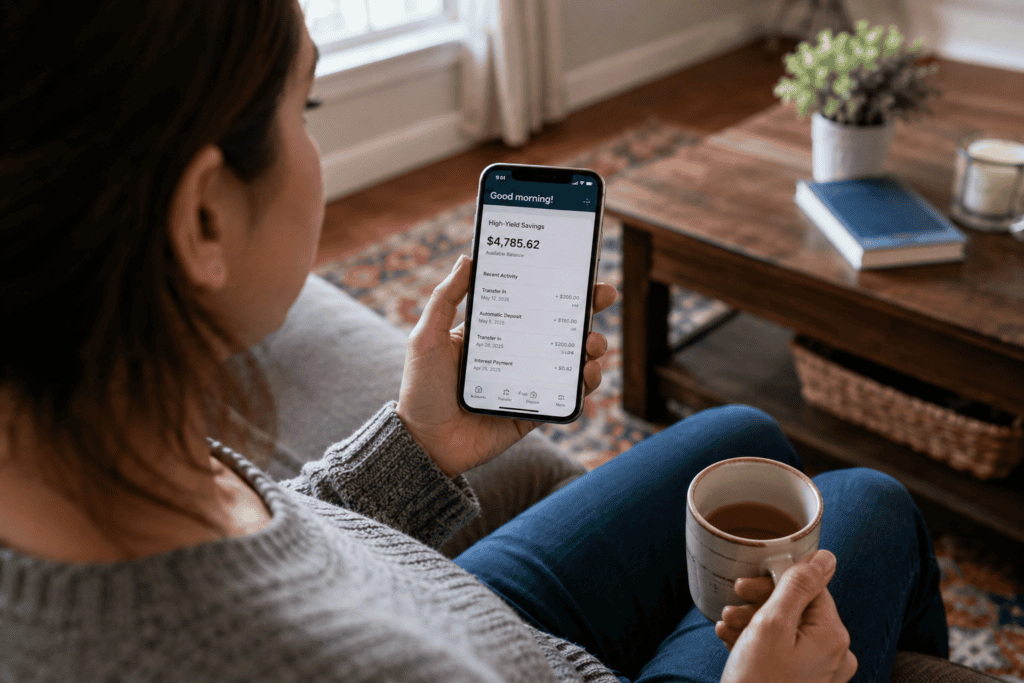
CHECKING HIGH-YIELD SAVINGS ACCOUNT
How to Build an Emergency Fund, Step by Step
Building a full emergency fund can feel overwhelming, especially if you are starting from zero. Breaking it into stages makes the process manageable.
Step 1: Open a Dedicated Account
Before you save a single dollar, open a separate, FDIC-insured savings account specifically for emergencies. Keeping this money apart from your everyday spending account reduces the temptation to dip into it for non-emergencies.
Step 2: Start with a Starter Fund
If your current savings are at or near zero, it may be more realistic to avoid aiming for six months of expenses right away. Instead, consider setting a small initial savings target, such as $500 or $1,000. After reaching it, continue building toward your longer-term emergency fund target. This example milestone already covers many of the most common emergencies, such as a car repair or an urgent appliance replacement, though your own first target should reflect your income, expenses, and comfort level.
Step 3: Automate Your Contributions
Set up an automatic transfer from checking to your emergency savings account on payday, even if the amount is small. Treating savings like a fixed bill, rather than whatever is left over at the end of the month, dramatically increases consistency. For example, saving $150 per paycheck across two paychecks a month builds $3,600 in a year without requiring a single manual decision.
Step 4: Direct Windfalls Toward Your Fund
Tax refunds, work bonuses, cash gifts, and rebate checks are ideal candidates for boosting your emergency fund quickly, since they are not part of your regular budgeted income. Directing even half of a windfall toward savings can meaningfully shorten your timeline.
Step 5: Trim Non-Essential Spending Temporarily
Look for short-term reductions rather than permanent lifestyle changes. Pausing one subscription, cooking at home a few extra nights a week, or delaying a discretionary purchase for a few months can free up real money without feeling like a major sacrifice.
Step 6: Add Temporary Income If Possible
A short-term side gig, selling unused items, or picking up extra hours can accelerate your progress, particularly while working toward your starter fund. This does not need to be permanent—even a few months of extra income can close a meaningful gap.
Step 7: Increase Your Target Gradually
Once your starter fund is in place, shift your goal toward one full month of expenses, then three, then six, adjusting your automatic transfer amount as your income allows. Momentum matters more than speed.
Finance Beacon Tip: If saving $7,200 over two years sounds intimidating, break it down: that is $300 a month, or about $150 per paycheck for most workers. Small, automatic amounts add up faster than most people expect.
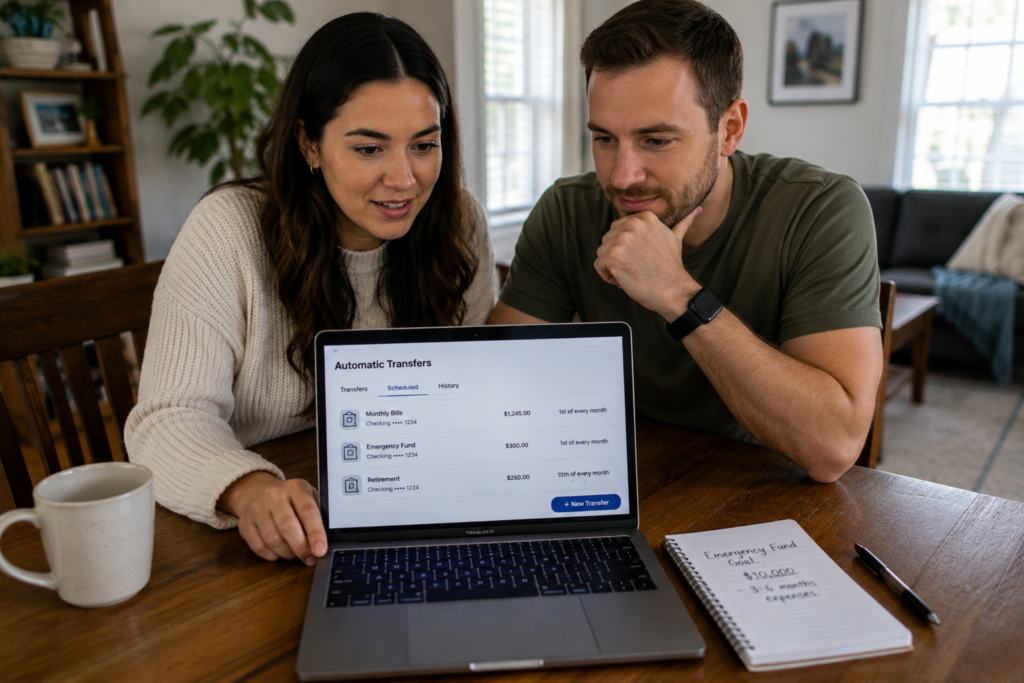
AUTOMATING EMERGENCY FUND SAVINGS
Common Emergency Fund Mistakes to Avoid
Even well-intentioned savers run into a handful of predictable mistakes.
Some savers treat the fund as optional after paying off debt. Others stop emergency contributions while reducing debt. This approach often creates a problem when the next unexpected expense arrives. Keeping at least a small starter fund active while paying down debt helps break that cycle.
Easy access to emergency savings can lead to overspending. Keeping this money separate from your daily spending account reduces the temptation to use it for non-emergencies.
Chasing high returns with risky investments can put your emergency savings at risk. Emergency savings should never sit in stocks, cryptocurrency, or other assets that can lose value. The goal is stability, not growth.
Setting Realistic Emergency Fund Goals
Setting an unrealistic first goal can be discouraging. Aiming directly for six months of expenses can feel so distant that many savers give up before making progress. A smaller starter fund keeps motivation high.
Some savers forget to rebuild the fund after using it. After tapping the fund for a genuine emergency, some savers forget to restart contributions, leaving the household exposed to the next unexpected expense. Rebuilding the fund should become a routine part of long-term financial health, not an afterthought.
Letting the fund sit at a non-competitive rate for years can be a costly mistake. Some savers open a high-yield account, then never check it again. Introductory rates and market conditions change, and an account that once paid a strong APY can quietly fall behind the national average over time. A brief annual check-in prevents this drift.
Confusing “emergency” with “irregular.” Expenses that happen every year, such as an annual insurance premium or holiday spending, are irregular rather than true emergencies. These costs deserve their own separate sinking fund, budgeted and saved for in advance, so they never compete with genuine emergencies for the same pool of money.
Emergency Fund vs. Paying Down Debt vs. Investing
A common question is whether to prioritize an emergency fund, debt payoff, or investing. In most cases, the smartest approach blends all three rather than choosing one exclusively.
A reasonable general order looks like this:
- Build a starter emergency fund using a small initial target, such as $500 or $1,000.
- Contribute enough to any employer retirement match to take full advantage of the benefit.
- Pay down high-interest debt, such as credit cards.
- Build your full emergency fund target.
- Increase retirement and other investment contributions.
This order exists because high-interest debt often costs more than an emergency fund can earn in interest, while a starter fund prevents new debt from being created in the meantime. Many households end up carrying both a credit card balance and an emergency fund at the same time, which is precisely why a clear priority order helps.
How Life Changes Affect Your Emergency Fund Target
Your emergency fund target is not fixed. Major life changes should trigger a fresh look at your target, since the risks you are protecting against shift over time.
Starting a New Job or Career
A new job, especially during a probationary period, can carry more income uncertainty than a long-held position. It is reasonable to keep your fund at the higher end of your range—or pause any planned drawdown—until the new role feels stable.
Having a Child
Dependents raise both your essential monthly expenses and the stakes of an income disruption. Many households increase their target after a child arrives, since childcare, medical costs, and general household expenses typically rise at the same time.
Buying a Home
A mortgage often replaces a smaller rent payment with a larger, less flexible obligation, plus new maintenance expenses that a landlord previously handled. Homeowners frequently find that their essential monthly expense figure—and therefore their emergency fund target—increases meaningfully after a purchase.
Approaching Retirement
As retirement approaches, some households choose a larger cash reserve because they rely less on employment income and might want to avoid selling investments during a market decline. There is no single figure that fits every pre-retiree, so the right cushion depends on your other income sources, such as Social Security or a pension, and how much investment risk you want to avoid near retirement.
Finance Beacon Tip: Treat your emergency fund target as a living number. Revisit it once a year, or any time your income, dependents, or housing situation changes significantly.
Keeping Your Emergency Fund Safe
Safety is not just about avoiding investment risk. It also means confirming your money is protected if your bank fails. The FDIC is the primary federal authority for deposit insurance at banks, insuring deposits up to $250,000 per depositor, per insured bank, for each account ownership category. The NCUA is the equivalent primary authority for federally insured credit unions, and its Share Insurance Fund provides the same $250,000 standard coverage per member, per insured credit union, for each account ownership category. Before opening any account for your emergency fund, confirm that the institution carries FDIC or NCUA coverage.
It is also worth reviewing your account periodically. As savings rates change, the account that offered the best yield last year may no longer be competitive. Checking your rate once or twice a year, without needing to switch banks constantly, helps ensure your fund continues to earn a reasonable return while remaining fully liquid.
Rate shopping does not have to mean closing accounts every few months. Many savers simply compare their current APY against a handful of top-rated online banks twice a year — once in the spring and once in the fall — and only move funds if the gap becomes significant. Since high-yield savings rates can shift with broader interest rate policy, a rate that looks competitive today may drift lower or higher within a year, so building this quick check into a recurring calendar reminder keeps the process effortless.
Frequently Asked Questions
General Emergency Fund Questions
What is an emergency fund used for?
An emergency fund covers unexpected, necessary expenses such as job loss, medical bills, urgent car repairs, or essential home repairs. It is not intended for planned purchases, vacations, or predictable annual expenses.
Is $1,000 enough for an emergency fund?
A $1,000 starter fund is one example of a strong first milestone and covers many common emergencies, but it is generally considered a starting point rather than a final goal. Your initial target might be smaller or larger depending on your circumstances. Most financial guidance still points toward a range of three to six months of essential expenses as the fuller, longer-term target, adjusted for your situation.
How fast should I build my emergency fund?
There is no fixed timeline. An initial milestone such as $500 or $1,000 is often achievable within a few months with consistent automated saving, while a full three-to-six-month fund commonly takes one to two years, depending on income and expenses.
Amount and Calculation Questions
How much should be in an emergency fund if I’m self-employed?
Self-employed workers and freelancers typically benefit from a larger cushion, often six months or more of essential expenses, since income can be less predictable than traditional employment.
Should my emergency fund include my mortgage or rent payment?
Yes. Housing is a core essential expense that should always be included in your calculation, since losing housing stability during an emergency creates additional financial and personal strain.
Where to Keep It Questions
Can I keep my emergency fund in a checking account?
You can, but it is generally not recommended. Checking accounts usually pay little to no interest, and keeping emergency savings mixed with everyday spending money increases the temptation to use it for non-emergencies.
Is it safe to keep my entire emergency fund in one bank?
As long as your balance stays within FDIC or NCUA insurance limits at that institution, yes. If your fund grows beyond those limits, consider spreading deposits across more than one insured institution.
Should I invest my emergency fund to earn a higher return?
No. Emergency funds should stay in stable, easily accessible accounts. Investments such as stocks can lose value at the exact moment you need the money most, which defeats the purpose of the fund.
Do I need more than one emergency fund account?
Most households only need one dedicated account. However, if your balance grows beyond a single institution’s FDIC or NCUA insurance limit, splitting deposits across two insured institutions keeps the entire balance protected.
What should I do if I need to use my entire emergency fund at once?
Treat a full withdrawal as a signal to restart Step 2 immediately—rebuild toward a small initial milestone first, such as $500 or $1,000, then work back up to your full target. Pausing other financial goals temporarily to rebuild is a reasonable trade-off, since you are otherwise exposed to the next unexpected expense with no cushion at all.
Key Takeaways
- An emergency fund exists to cover unexpected, necessary expenses without relying on debt.
- An initial milestone, such as $500 or $1,000, is a realistic example of a first goal if you are starting from zero, though your number should reflect your circumstances.
- A common long-term target is three to six months of essential expenses, adjusted for your income stability and household obligations.
- High-yield savings accounts and money market accounts offer the best balance of safety, access, and return for most savers.
- Automating contributions and directing windfalls toward savings are two of the most effective ways to build a fund consistently.
A Simple Printable Emergency Fund Checklist
Calculate essential monthly expenses
Set your savings target at three or six months based on your personal risk factors.
Use a separate savings account insured by the FDIC or NCUA.
☐Begin with an achievable milestone, such as $500 or $1,000.
☐ Schedule automatic transfers for each payday.
☐ Put at least half of unexpected extra income into your emergency fund.
☐Check your account’s interest rate once or twice each year.
☐ After using the fund, start replenishing it as soon as possible.
Final Thoughts
An emergency fund will not stop unexpected expenses from happening. What it does is change what happens next. Instead of reaching for a credit card or a high-interest loan, you reach for money you already set aside—money with no interest attached and no long-term consequences. Whether you are starting with $50 or already have a full six months saved, the most important step is the next automatic transfer, not a perfect number on a spreadsheet.

6 Comments