In This Article
Budgeting for beginners starts with understanding where your money goes and deciding what you want it to do. It means creating a plan for how you will use your income. Start by calculating your take-home pay, tracking your spending, separating essential expenses from optional spending, setting savings and debt goals, and choosing a budgeting method. Finally, review your budget every month and adjust it when your income, expenses, or priorities change.
Introduction
Your paycheck arrives on Friday. You pay rent. You buy groceries. A subscription renews. You fill your car with gas. During the week, you order dinner twice. Before long, another credit card payment leaves your account. Two weeks later, you check your bank account and wonder where the money went.
For many people, this experience has little to do with irresponsibility. Instead, the problem is often simple. Their money had no plan before they started spending it. As a result, a budget gives every dollar a clear purpose.
Importantly, budgeting does not mean eliminating everything you enjoy. It means deciding where your money should go before dozens of small spending decisions make the choice for you.
This matters because many American households have limited room for unexpected costs. The Federal Reserve reported in 2026 that 63 percent of U.S. adults said they would cover a hypothetical $400 emergency expense using cash or its equivalent. The figure has stayed at 63 percent since 2022.
Ultimately, a working budget helps you create more room between what you earn and what you spend. This guide shows you how to build one from scratch.
1. Budgeting for Beginners: What Is a Budget?
A budget is a plan for your income. It answers four basic questions. How much money comes in? Where does your money currently go? What expenses must you pay? What do you want to do with the money left over?
However, a budget does not create more income by itself. It helps you make better decisions with the income you already have.
For example, suppose your monthly take-home income is $4,000. Without a budget, you might spend throughout the month and save whatever remains. With a budget, you decide before the month starts that your $4,000 has specific jobs.
2. Why Budgeting Matters
A budget gives you visibility. When you know where your money goes, financial decisions become easier. You see whether housing consumes too much of your income. At the same time, unused subscriptions become easier to identify. You might also notice that restaurant spending has increased. Finally, you see how much you are saving
Federal Reserve data show why this matters. In 2025, 55 percent of adults reported having emergency savings sufficient to cover three months of expenses. Among adults who always had money left at the end of the month, 86 percent had three months of emergency savings. Among those who never had money left, just 13 percent had such savings. For this reason, budgeting for beginners should first focus on spending habits. Strict spending limits can come later.
A budget helps you work toward having money left over intentionally.
3. Budgeting Is Not About Depriving Yourself
One reason people abandon budgets is simple. They make the budget too restrictive.
A plan that leaves no money for entertainment, eating out, hobbies, or personal spending often becomes difficult to maintain. Think of budgeting as prioritization.
Include dining out if it matters to you. For instance, you could set aside a separate fund for travel. Likewise, give gaming, books, sports, or streaming services a reasonable spending category if they matter to you.
The objective is to spend intentionally.
4. Step 1: Calculate Your Monthly Take-Home Income
Start with the money you receive after taxes and payroll deductions. For a salaried employee, review your pay statement and calculate your normal monthly take-home pay.
If you receive two paychecks each month, add them together. If you are paid every two weeks, you receive 26 paychecks during a typical year. You might base your regular monthly budget on two paychecks and treat the two extra checks during the year separately.
However, if your income changes each month, review the previous six to twelve months and identify a reasonable conservative baseline. For freelancers, contractors, commission workers, and business owners, budgeting from a conservative income estimate reduces the risk of committing money you have not yet earned.
5. Step 2: Find Out Where Your Money Goes
First, before deciding how to spend, understand how you currently spend your money. Next, review at least one full month of transactions. Three months gives you a clearer picture because some expenses fluctuate.
Check checking accounts, credit cards, digital wallets, payment apps, cash withdrawals, loan payments, and automatic subscriptions. Do not judge the transactions yet. Record them.
Many budgeting problems become obvious during this exercise.

- KEEP YOUR FINANCES ORGANIZED, ALL IN ONE PLACE: Clever Fox Budget Planner & Bill Organizer with pockets will help you ma…
- MAKE A BUDGET, MONITOR EXPENSES & STORE BILLS: Every month, plan your spending, track daily expleses, and keep your fina…
- SET & ACHIEVE YOUR FINANCIAL GOALS STRATEGICALLY: This financial planner organizer budget book helps you set big money g…

Tracking Monthly Expenses Before Creating a Budget
6. Separate Fixed and Variable Expenses
Next, divide your expenses into fixed and variable categories. Fixed expenses tend to stay similar each month, such as rent or mortgage, car payments, insurance premiums, internet service, phone plans, loan payments, and subscriptions.
By contrast, variable expenses change. Examples include groceries, gas, electricity, dining out, entertainment, clothing, personal care, and household purchases. Variable expenses give you more room to cut spending when needed.
7. Separate Needs From Wants
Needs generally include expenses required for basic living and financial obligations, such as housing, basic food, utilities, transportation to work, insurance, medication, and minimum debt payments.
Wants to improve comfort or enjoyment, such as restaurant meals, premium subscriptions, vacations, entertainment, luxury purchases, and upgrades.
The distinction is not always perfect. Use your circumstances rather than someone else’s list.
8. Identify Irregular Expenses
Unfortunately, many budgets fail because they account for monthly bills but ignore expenses that arrive less frequently. Consider annual insurance premiums, car registration, property taxes, holiday gifts, school expenses, vehicle maintenance, home repairs, professional fees, travel, medical deductibles, and annual subscriptions.
For example, suppose your car insurance costs $1,200 every six months. Instead of treating the bill as a $1,200 emergency twice a year, budget $200 each month. The money accumulates until the payment arrives.
9. What Is a Sinking Fund?
A sinking fund is money you gradually save for an expense you expect in the future. An emergency fund covers unexpected events. A sinking fund covers expected expenses with uncertain or distant dates.
Examples include car repairs, Christmas gifts, vacation, home maintenance, a new laptop, wedding expenses, and annual insurance. If you expect to spend $1,200 on a vacation 12 months from now, save $100 each month.
10. Step 3: Budgeting for Beginners, Choose Your Budgeting Method
There is no single budgeting system suitable for everyone. The best method is the one you understand and consistently follow. Three approaches work well for beginners.
11. The 50/30/20 Budget
The 50/30/20 approach divides after-tax income into three broad categories. About 50 percent goes to needs, 30 percent to wants, and 20 percent to savings and debt repayment.
Suppose you bring home $4,000 per month. Your broad targets become $2,000 for needs, $1,200 for wants, and $800 for savings and additional debt repayment.
The strength of this method is simplicity. The weakness is that the percentages might not fit your circumstances. Treat them as a framework rather than a rigid rule.
12. Zero-Based Budgeting
Zero-based budgeting gives every dollar of income a job. Income minus planned spending, saving, investing, and debt repayment equals zero.
Zero does not mean your bank account is zero. It means no income remains unassigned. This method provides strong control over spending, but it requires more maintenance than a broad percentage budget.
13. Pay Yourself First
A pay-yourself-first budget prioritizes saving. Instead of treating savings as whatever remains after spending, you set aside savings first and build your spending plan around that amount.
If you earn $4,000 and want to save $600, transfer that amount soon after payday. Automatic transfers make this method easier.
14. Which Budgeting Method Should You Choose?
Choose 50/30/20 if you want simplicity. For more detailed control, consider zero-based budgeting. Alternatively, pay yourself first if saving is your main priority and your expenses are already under control.
You can combine them. For example, use 50/30/20 to establish broad targets, then use zero-based budgeting within each category.
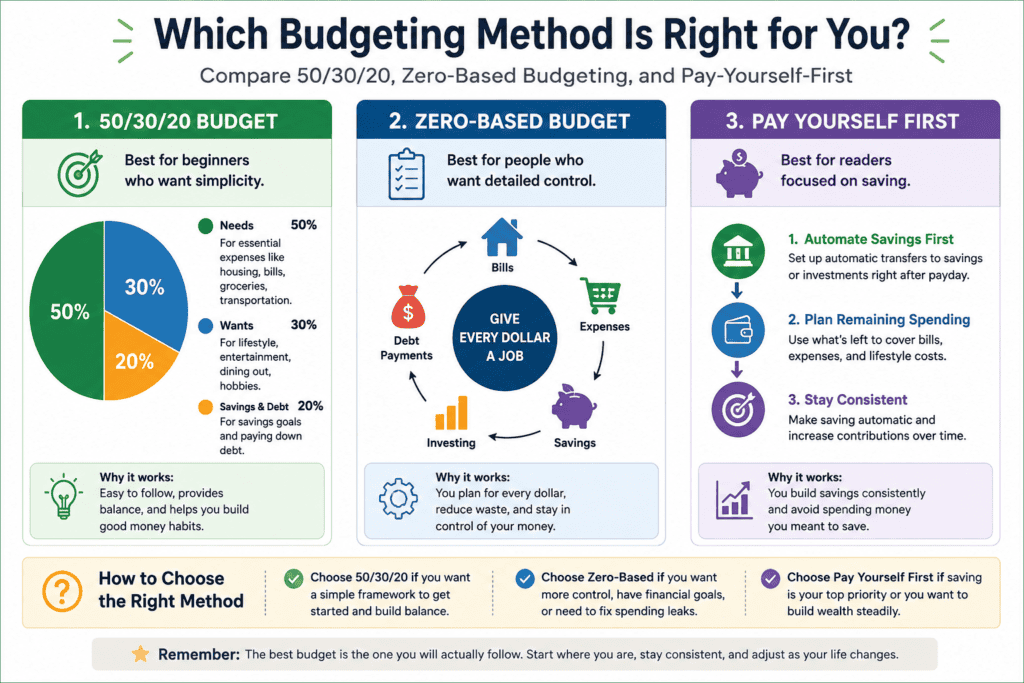
Which Budgeting Method Is Right for You? Compare 50/30/20, zero-based budgeting, and pay-yourself-first.
Helpful Budgeting Tool: Budget Binder and Cash Envelope System

- Value Package:This versatile cash organizer set includes a budget binder, 12pcs cash envelopes for budgeting, 2pcs categ…
- Marble Budget Binder:Money saving binder made from durable PU leather. A6 binder has attractive marble cover and magneti…
- Practical Function:Onlyesh budget binder has many hidden compartments and pen holders. These cash envelopes for budgetin…
15. Step 4: Set Financial Priorities
A budget becomes more useful when it connects daily spending to specific goals. Your priorities might include building an emergency fund, paying off credit cards, saving for a house, buying a car, taking a vacation without borrowing, starting retirement contributions, building an investment portfolio, paying student loans, or starting a business.
Choose a few priorities rather than trying to accomplish everything at once.
16. Start an Emergency Fund
A budget needs protection from unexpected expenses. Without savings, one car repair or medical bill might push you toward credit card debt.
The Federal Reserve reported that 12 percent of adults in 2025 said they would be unable to pay a hypothetical $400 emergency expense by any means.
Start with an achievable target. For some households, the first goal might be $500, then $1,000. From there, work toward a larger reserve based on your essential expenses and circumstances.
FinanceBeacon’s upcoming Emergency Funds Explained guide will cover this subject in detail.
17. Step 5: Build Your First Monthly Budget
Assume Jordan earns $4,200 per month after taxes. Jordan assigns the full amount across housing, utilities, groceries, transportation, insurance, communications, debt payments, emergency savings, retirement, discretionary spending, sinking funds, and miscellaneous expenses. This example shows how budgeting for beginners works in practice, with every major expense and financial goal receiving a planned amount.
The key is not copying Jordan’s numbers. The key is making your own income equal your planned allocations.
18. Budget With Your Bank Account
Your banking setup affects how easy your budget is to follow. A simple system might include one checking account for income and bills, one savings account for emergencies, separate savings buckets where available, automatic transfers on payday, balance alerts, low-balance notifications, and recurring bill reminders.
19. How to Budget When You Live Paycheck to Paycheck
Budgeting feels harder when almost every dollar already has a destination. Start with survival expenses, including housing, food, utilities, transportation required for work, insurance, medication, and minimum required debt payments.
Then examine everything else. The first objective might not be investing 20 percent of your income. It might be creating a $100 monthly margin. If maintained for a year and left unspent, $100 per month becomes $1,200 before interest.
20. How to Budget With Irregular Income
Income often changes from month to month for freelancers, contractors, business owners, and commission workers. First, identify your minimum monthly expenses. Then set a safe baseline for your monthly income.
If you earn more than your baseline, decide where the extra money will go. Taxes require separate planning when your income varies.
Employees with federal income tax withheld from wages, pensions, or annuities can review their withholding using the IRS Tax Withholding Estimator. Self-employed workers and freelancers should review the IRS rules for estimated tax payments instead of relying on the withholding estimator alone.
21. Budgeting as a Couple
For example, money disagreements often start when two people have different priorities. One person values saving. The other values experience. One prefers detailed tracking. The other dislikes spreadsheets.
A shared budget should begin with shared goals.

couple budgeting
Discuss household income, fixed obligations, existing debts, individual spending, savings targets, major purchases, and financial responsibilities. Agree on an amount each person has for personal spending without needing approval for every purchase. Transparency matters more than choosing a particular budgeting method.
22. Common Budgeting for Beginners Mistakes
Common mistakes include creating an unrealistic budget, forgetting irregular expenses, removing all enjoyable spending, failing to track actual spending, treating one disappointing month as failure, increasing lifestyle spending every time income rises, and using credit cards to hide overspending.
Your planned budget and actual spending are different things. Review both and adjust.
23. Myth vs. Fact
Myth: Budgeting is only for people with money problems. Fact: A budget helps people at many income levels decide how to allocate money.
Myth: Budgeting means you cannot have fun. Fact: You decide which enjoyable expenses deserve space in your plan.
Myth: You need complicated software. Fact: A notebook or spreadsheet works if you use it consistently.
Myth: A budget must be perfect. Fact: A useful budget changes as your circumstances change.
24. Five Budgeting Case Studies
Case Study 1: The New Graduate
Situation: Maya earns $3,200 per month after taxes.
Challenge: Student loan payments, rent, and social spending leave little money for savings.
Solution: She tracks spending for a month and finds $280 going toward restaurant meals and unused subscriptions. She cuts $150 and automates it into savings.
Outcome: If maintained, the $150 monthly transfer adds $1,800 over 12 months before interest.
Case Study 2: The Family With Rising Expenses
Situation: Daniel and Grace have two children.
Challenge: Food, childcare, and utilities have increased.
Solution: They review three months of spending, cancel unused subscriptions, plan meals weekly, and create sinking funds for school expenses and car maintenance.
Outcome: Irregular bills become easier to manage because they have already reserved money for them.
Case Study 3: The Freelancer
Situation: Marcus earns between $3,000 and $6,000 per month.
Challenge: He spends heavily during strong months and struggles during slower months.
Solution: He creates his budget around a conservative baseline and saves part of higher-income months.
Outcome: His stronger months start funding weaker months instead of increasing lifestyle expenses.
Case Study 4: The Credit Card Borrower
Situation: Rachel has several credit card balances.
Challenge: She saves inconsistently while paying substantial interest.
Solution: She builds a starter emergency reserve, maintains required minimum payments, and directs additional available money toward her debt repayment strategy.
Outcome: Her budget gives debt repayment a defined monthly allocation instead of relying on whatever remains.
Case Study 5: The Higher Earner Who Still Feels Broke
Situation: Chris earns $8,000 per month after taxes.
Challenge: Lifestyle spending expanded as his income increased.
Solution: He reviews recurring expenses, sets automated savings targets, and limits discretionary spending.
Outcome: His budget creates a measurable gap between income and spending.
25. A Simple Weekly Budget Routine
A budget does not need daily attention. Try a 15-minute weekly review.
- Check your bank and credit card balances.
- Review recent transactions.
- Compare spending with your categories.
- Review upcoming bills.
- Move money if a category needs adjustment.
- Review progress toward one financial goal.
Consistency matters more than spending hours analyzing every purchase.
26. Your 30-Day Budgeting Action Plan
This 30-day plan turns budgeting for beginners into a simple process you can follow one week at a time.
Week 1
- Calculate your monthly take-home income.
- Review recent transactions.
- List fixed bills.
- Track every expense.
- Identify recurring subscriptions.
Week 2
- Categorize your spending.
- Separate needs from wants.
- Identify irregular expenses.
- Choose your budgeting method.
- Create your first monthly plan.
Week 3
- Set one savings goal.
- Create an emergency savings transfer.
- Choose one spending category to reduce.
- Create sinking funds for predictable large expenses.
Week 4
- Compare planned spending with actual spending.
- Adjust unrealistic categories.
- Review upcoming expenses.
- Set next month’s budget.
- Schedule a recurring monthly budget review.
27. Frequently Asked Questions
General Budgeting Questions
What is the easiest budget for beginners?
A simple percentage-based budget often provides an accessible starting point because it limits the number of categories you need to manage.
What is the 50/30/20 budget?
It allocates roughly 50 percent of after-tax income to needs, 30 percent to wants, and 20 percent to savings and debt repayment.
Does the 50/30/20 rule work for everyone?
No. Housing costs, debt, income, family size, and location differ. Adjust the percentages to fit your situation.
What is zero-based budgeting?
It assigns every dollar of income to spending, saving, investing, or debt repayment until no income remains unassigned.
How much should I save each month?
Choose an amount your budget supports consistently, then increase it as your finances improve.
Should I budget before or after taxes?
For household spending, using take-home income usually makes the plan easier because it reflects money reaching your account.
How do I start budgeting when I am broke?
Start by listing income and essential expenses. Your first goal might be finding a small monthly surplus rather than meeting an arbitrary savings percentage.
How do I budget with irregular income?
Use a conservative income baseline and build reserves during stronger months.
Should savings count as an expense?
Treating savings as a planned allocation makes it less likely you will spend the money elsewhere.
What expenses do people commonly forget?
Car maintenance, annual subscriptions, gifts, medical costs, insurance premiums, school expenses, travel, and home repairs.
How often should I review my budget?
Review transactions briefly each week and complete a fuller review before each new month.
Should couples combine finances?
There is no universal answer. Couples need clear agreements about shared expenses, goals, debts, savings, and personal spending.
Savings and Emergency Fund Questions
What is a sinking fund?
It is money gradually saved for a known future expense.
Is an emergency fund part of a budget?
Yes. Regular emergency savings should have a planned place in your monthly budget.
Should I pay debt or save?
The answer depends on interest rates, emergency reserves, employer benefits, and your financial circumstances. Many people maintain some emergency savings while prioritizing expensive debt.
Budgeting Tools and Spending Questions
Do I need a budgeting app?
No. Paper, spreadsheets, and apps all work. Consistency matters more than format.
What if I overspend?
Adjust the remaining categories or revise the budget. Do not abandon the entire plan because one category went over.
Should I use cash for budgeting?
Cash works well for people who control discretionary spending better when they physically see money leaving an envelope.
How do I stop impulse spending?
Create spending limits, remove saved payment details, use a waiting period before nonessential purchases, and avoid browsing shopping sites without a planned purchase.
How much should I budget for groceries?
Use your household’s actual spending as a starting point, then set a realistic target based on family size, location, dietary needs, and income.
What if my expenses exceed my income?
Prioritize essential expenses, reduce flexible spending, review fixed costs, and explore ways to increase income. Persistent deficits require structural changes rather than increasingly restrictive categories.
Budgeting and Long-Term Financial Goals
Should investments appear in my budget?
Yes. Regular investment contributions should appear as planned allocations.
What happens when my income increases?
Decide how much of the increase goes toward saving, investing, debt repayment, and lifestyle spending before your expenses expand automatically.
What is the most significant budgeting mistake?
Creating a plan based on how you wish you spent rather than how you realistically live.
When should I start budgeting?
Start with your next paycheck or your next full month. You do not need to wait for January.
28. Key Takeaways
- Budgeting is a plan for your income.
- Start with take-home pay.
- Track actual spending before setting aggressive targets.
- Separate fixed expenses from variable expenses.
- Account for irregular expenses.
- Choose a budgeting system you will follow.
- Be sure to include specific places for savings and debt repayment in your plan.
- Use sinking funds for predictable future costs.
- Review your budget regularly.
- Adjust it when life changes.
Conclusion
A successful budget does not need to look impressive. It needs to work.
Start by understanding your income and current spending. Then create realistic categories, give your financial goals a place in the plan, and review your progress regularly.
Your first budget will not be perfect. Your second will be better because you will have a month of real information. Over time, budgeting changes from guessing where your money went to deciding where it goes.
To build a broader financial foundation, check out FinanceBeacon’s What Is Personal Finance? A Complete Beginner’s Guide to Managing Your Money.
For help choosing and using bank accounts, read The Complete Beginner’s Guide to Banking.