In This Article
Broad market exposure can be simple, yet index funds vs ETFs often feels like a confusing choice when you’re new to investing. Both can put your money into hundreds of companies at once, but they differ in how you buy them, what they cost, and how easily they fit into your routine.
Before investing, build a cash buffer for unexpected bills. A solid beginner’s guide to personal finance can help you put savings, debt, and investing in the right order.
Neither option automatically wins. The better fit depends on your account, habits, time horizon, and ability to keep contributing when markets are unsettled.
Key Takeaways
- An index fund follows a market benchmark, while an ETF is a fund structure that trades on an exchange. An ETF can also be an index fund.
- Broad, low-cost funds can offer diversification, but they still rise and fall with the markets they hold.
- ETFs offer intraday trading, while mutual fund index funds usually price once each business day.
- Automatic contributions may matter more than trading features if you want a low-maintenance investing habit.
- Read the current prospectus, fee schedule, and broker terms before buying. Fund costs, minimums, taxes, and available features can change.
What Are Index Funds and ETFs, and How Do They Work?
An index fund is built to follow a market index rather than having a manager select stocks in an attempt to beat it. For example, a fund that tracks the S&P 500 owns shares in many large U.S. companies, so an investor buys a small piece of the whole basket.
An ETF, or exchange-traded fund, is a pooled investment that trades on a stock exchange. FINRA explains that ETFs, like mutual funds, give investors an interest in a diversified portfolio of investments. A fund may hold stocks, bonds, or other assets.
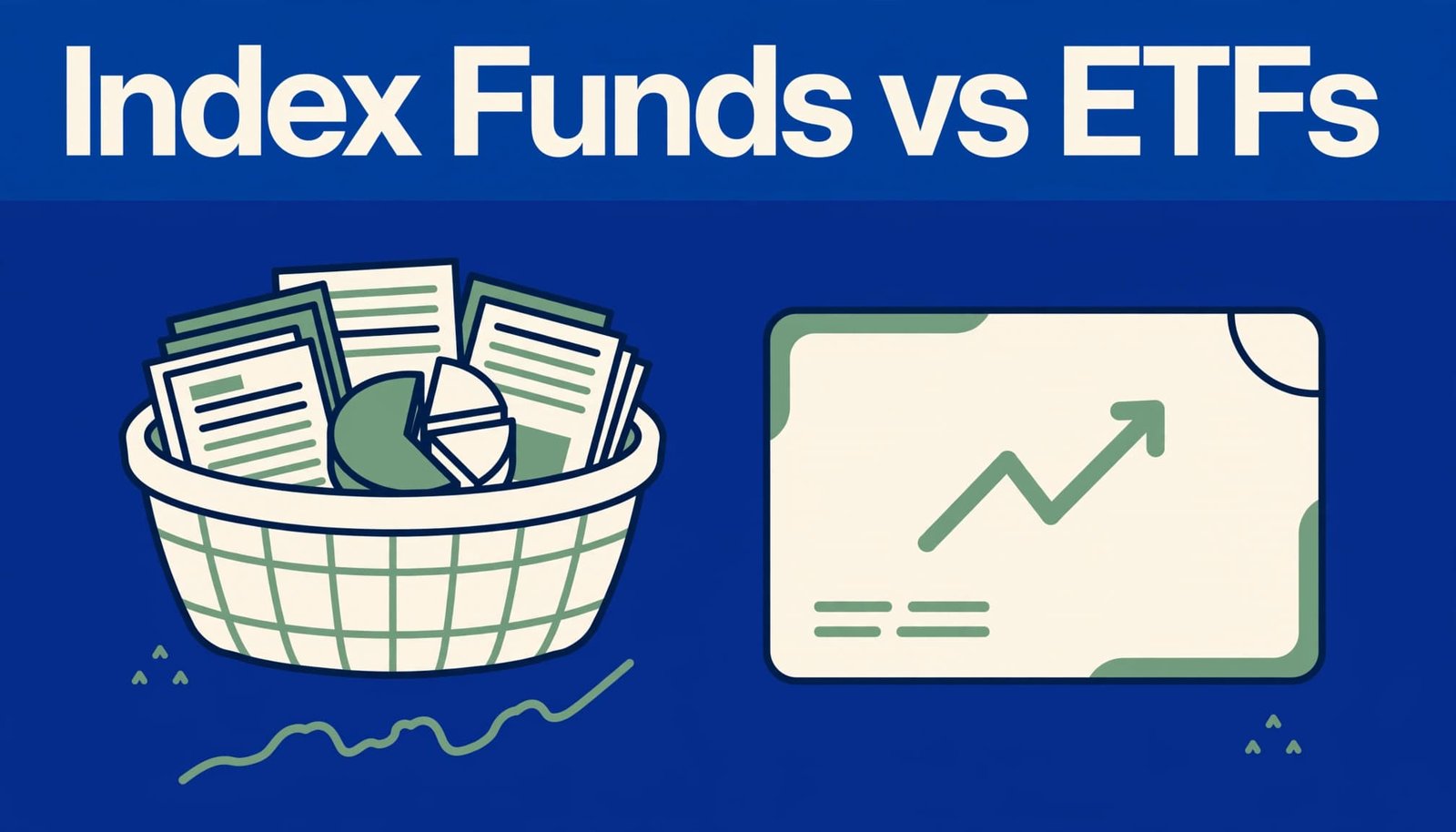
Index funds vs ETFs often comes down to how the fund is structured and traded.
The Main Difference Is Fund Structure, Not Investment Strategy
The words describe different things. “Index fund” describes an investment strategy, while “ETF” describes a trading structure.
Many ETFs track indexes. However, many index funds use the mutual fund structure instead. M1 Finance’s index fund overview uses the S&P 500 as a familiar example of an index a fund can follow.
Two funds may track the same index and own nearly identical holdings. One may trade all day as an ETF, while the other accepts mutual fund orders at the end of the day. That distinction affects your buying experience, not necessarily the investments inside.
How You Buy and Sell Each Type of Fund
ETF prices move during market hours. You can place a market order, which seeks the current available price, or a limit order, which sets the highest price you will pay or lowest price you will accept.
The bid-ask spread is the gap between what buyers offer and sellers request. A narrow spread usually means less friction when you trade. ETF market-price information also shows why an ETF’s exchange price can differ from the value of its underlying holdings.
Mutual fund index orders usually process once each business day at net asset value, or NAV. NAV is the per-share value of the fund’s assets after subtracting liabilities. ETFs typically require a brokerage account, while some mutual funds are available directly from the fund company.
Index Funds vs ETFs: Which Is Better for Beginners?
The central comparison is practical. A beginner who wants automated deposits may prefer one structure, while someone using a standard brokerage may find the other easier.
| Feature | ETF | Mutual Fund Index Fund |
|---|---|---|
| Pricing | Changes during trading hours | Usually priced once daily at NAV |
| Minimum investment | Often flexible, especially with fractional shares | Depends on the fund and provider |
| Automatic investing | Broker-dependent | Often built into the fund account |
| Trading controls | Market and limit orders available | End-of-day order processing |
| Tax efficiency | Can be favorable in some taxable accounts | Depends on fund activity and structure |
| Costs | Expense ratio, spread, and possible account fees | Expense ratio, minimums, and possible transaction fees |
Check a fund’s current prospectus and your broker’s fee schedule. General labels don’t reveal every cost or restriction.
When an ETF May Be the Easier Choice
ETFs may suit investors who want broad provider choice and the ability to buy through one brokerage account. They can also be useful when you want to start with a smaller dollar amount.
Fractional ETF shares let some investors buy part of a share, but availability depends on the broker and the fund. Automatic ETF purchases also vary by provider.
Live prices can tempt people to watch every market dip. Long-term investors don’t need to monitor an ETF throughout the day. A diversified ETF bought for a decade-long goal should not become a daily trading project.
When a Mutual Fund Index Fund May Fit Better
A mutual fund index fund can feel more natural if you want to invest the same amount from every paycheck. Many fund companies and retirement plans support recurring contributions and automatic dividend reinvestment.
End-of-day pricing also removes the urge to pick the “perfect” moment during the trading session. That can support a calmer buy-and-hold routine.
Still, compare the actual terms. Some mutual funds have minimum investments, transaction fees, account restrictions, or limited availability outside a workplace retirement plan. Others have low costs and simple access.
The Costs That Matter More Than the Label
The expense ratio is the annual percentage a fund deducts from assets to cover operating expenses. Lower costs leave more of your investment invested, although they don’t guarantee stronger returns.
A small fee difference compounds over time. If two similar funds earn the same gross return, the fund with the lower expense ratio leaves more money after expenses each year. Charles Schwab’s guide to ETF expense ratios and other costs shows why investors should look beyond a fund’s headline price.
Also consider trading commissions, bid-ask spreads, account fees, fund minimums, and whether an ETF trades at a premium or discount to NAV. Diversification, tracking accuracy, and steady contributions matter alongside cost.
How to Choose the Right Fund for Your First Investment
Start with the purpose of the money. A near-term home deposit or emergency reserve doesn’t belong in a volatile stock fund. A retirement goal that is decades away may call for a different level of risk.
Review your wider position before choosing investments. Calculating cash, debt, property, and accounts can clarify how much market risk fits your finances.
Match the Fund to Your Account and Investing Routine
In a taxable brokerage account, ETFs may offer flexibility and potentially favorable tax treatment. The Congressional Research Service explains that ETF structure can support tax efficiency, but it does not promise lower taxes for every investor.
Taxes depend on your country, income, account type, holding period, fund activity, and personal situation. Tax rules also differ across providers and jurisdictions.
Workplace retirement plans may offer a limited menu of mutual funds. Individual retirement accounts may offer mutual funds, ETFs, or both. If your account supports automatic transfers, that feature can matter more than a small difference in daily trading options.
Check Diversification and Risk Before You Buy
A low expense ratio doesn’t make a fund low risk. Look at the index it follows, its top holdings, the number of securities, and the markets or sectors it covers.
A broad U.S. stock-market fund spreads money across many companies. A technology-sector ETF may hold fewer types of businesses and can move more sharply. International stock funds, bond funds, and single-country funds each bring different risks.
A fund can hold hundreds of securities and still carry substantial risk if those securities move together.
Market volatility can reduce the value of both ETFs and mutual fund index funds. You can lose money, especially over short periods, so invest only money you can leave invested for the appropriate time horizon.
A Simple Beginner Plan for Buying and Holding
Keep the first purchase boring and understandable. Open an appropriate account, compare a small group of diversified funds, and read the fund’s objective, holdings, risks, expense ratio, and order rules.
Then make an initial investment and set up recurring contributions if your provider allows them. Review the plan periodically, such as once or twice a year, rather than reacting to ordinary market noise.
Questions to Ask Before Placing Your First Order
Before buying, confirm these details:
- What index does the fund track, and what assets does it actually hold?
- How diversified is the portfolio, and does its risk match your goal’s timeline?
- What is the expense ratio, and are there trading, account, or transaction fees?
- Does the account allow recurring deposits, fractional shares, or automatic reinvestment?
- How will the order be priced, and what tax rules may apply to this account?
Fund documents and broker disclosures provide the most current answers. Products change, and an option that suits one investor may not suit another.
Avoid Common First-Investment Mistakes
Recent performance attracts attention, but it doesn’t predict future results. Chasing a fund after a strong year can lead you to buy an investment you don’t understand.
Avoid panic selling when a broad market fund declines. Price swings are part of stock investing, and selling after a drop can turn a temporary loss into a permanent one.
Narrow sector funds also deserve caution. They may have low fees and popular holdings, yet still be far less diversified than a broad-market fund. A simple plan is often easier to maintain.
Choosing a Structure You Can Stick With
For most beginners, a broadly diversified, low-cost ETF or mutual fund index fund can be a sensible place to start. The fund’s structure matters, but your account features, fees, diversification, and investing routine matter more.
The strongest answer to index funds vs ETFs is often the option that lets you contribute regularly without taking risks you don’t understand. A realistic long-term plan can outlast the daily noise of the market.